



Paul Byrne | Head | Data Insights | Pnet | mail me |
We have released our March Job Market Trends Report. The report includes an analysis of how Artificial Intelligence (AI) skills are evolving locally. It draws on data from the company’s recruitment platforms.
The findings show that AI exposure among professionals has shifted from niche to mainstream. This shift signals the rise of the growing AI skills economy.
The AI shift
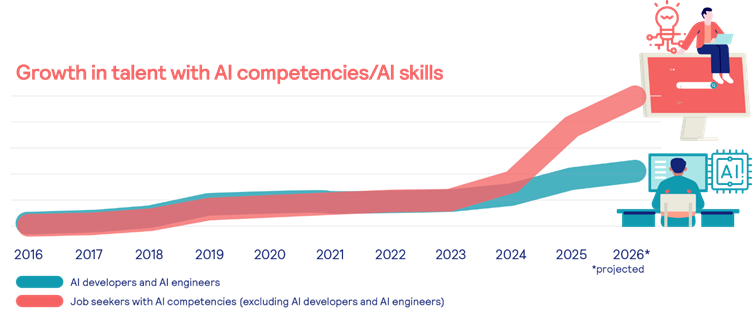
Our data highlights a notable increase in AI-related skills between 2016 and 2019. This growth came mainly from technical roles such as Developers and Data Specialists. However, even during this period, non-technical talent showed strong alignment.
In fact, there was 98% alignment between non-tech AI competency growth and technical AI roles. This suggests that many professionals had already started engaging with AI applications. As a result, the growing AI skills economy began forming earlier than many expected.
From 2023, the launch of ChatGPT accelerated adoption significantly. Generative AI moved into the mainstream. Consequently, AI adoption expanded across a much wider range of roles. This moment marked a clear inflection point. Job seekers with AI competencies began to grow faster than Engineers and Developers who build AI systems. This trend reflects the rapid expansion of the growing AI skills economy.
Some professionals used early AI tools as far back as 2010. For example, Bookkeepers used the Dext AI-powered system. However, these cases were exceptions at the time. Today, AI tools operate across many professions. Professionals use them to improve productivity, decision-making, and efficiency.
– Anja Bates
This shift reflects a broader workplace transformation. AI no longer sits only within technical roles. Instead, it integrates into everyday workflows. Maturing generative AI tools have driven this change. As a result, AI has become more accessible. Professionals can now apply automation and intelligence without advanced technical expertise. This accessibility continues to fuel the growing AI skills economy.
AI literacy over time
Although AI has existed for decades, generative AI has accelerated adoption since 2023. This acceleration has increased the value of AI literacy.
Data from users and job postings shows strong demand across several sectors:
-
Information Technology
Developers, Engineers and Data Specialists build AI systems. They also use AI tools to streamline coding, testing and deployment.
-
Business & Management
Leaders use AI tools for decision-making and strategy. They analyse data to improve performance and speed.
-
Education & Training
Institutions and partnerships introduce AI programmes. These initiatives prepare students with future-ready digital skills.
-
Admin, Office & Support
Administrative professionals automate routine tasks. They also manage workflows and improve productivity using AI tools.
-
Finance
Finance professionals adopt AI tools early. They use them for bookkeeping, reporting, and data processing.
-
Design, Media & Arts
Designers and creators use generative AI. They accelerate production and enhance creativity.
-
Architecture & Engineering
Professionals use AI to optimise design. They also improve planning and address sustainability challenges.
-
Marketing
Marketers use AI to gain insights. They automate campaigns and enhance content creation.
-
Manufacturing & Assembly
AI supports predictive maintenance and quality control. It also improves process optimisation.
-
Sales
Sales teams use AI to improve lead generation. They personalise outreach and strengthen customer engagement.
These trends show how widely AI has spread across industries. They also reinforce the expansion of the growing AI skills economy.
Top AI skills and tools in South Africa
It is important to distinguish between AI development and AI application skills. AI development skills focus on building systems. In contrast, AI application skills focus on using tools in daily roles.
The market demands IT professionals with machine learning expertise. It also requires skills in natural language processing and chatbot development. At the same time, non-technical roles require proficiency in tools such as ChatGPT, Dext and Zapier. This combination reflects the dual nature of the growing AI skills economy.
Our data shows a shift from specialised expertise to widespread adoption. As AI tools become more accessible, professionals must build relevant skills. Those who do so will remain competitive in a changing job market. Therefore, the growing AI skills economy rewards adaptability and continuous learning.
For job seekers, even basic AI literacy improves employability. For employers, attracting AI-skilled talent drives innovation and productivity. Ultimately, the growing AI skills economy will shape the future of work in South Africa.