





Getting Google’s “AI Overviews” to highlight your site comes down to three things:
- The organic strength of your website.
- The way you label your page.
- The way you structure your copy.
Did you feel that was an abrupt start to an article?
Well, buckle up. That style mirrors the kind of writing Google’s AI Overviews might favour.
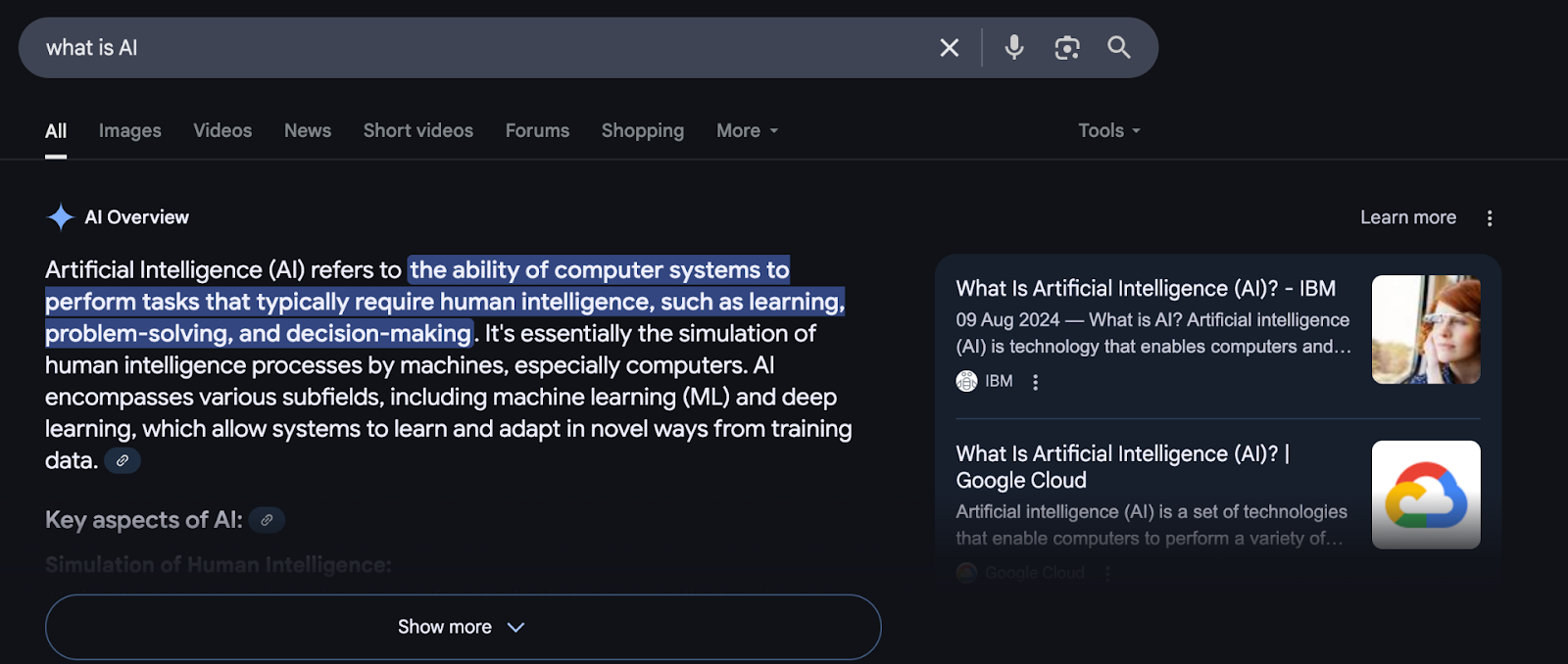
Source: Google
When Google launched the feature in 2023, two things were immediately clear:
- It was the search giant’s response to the meteoric rise of Large Language Models (LLMs) such as ChatGPT.
- It disrupted Google’s vast ecosystem. This ecosystem comprises billions of indexed websites filled with content that Google organises, ranks and – most importantly – monetises.
The first point is easy to grasp. LLMs have become popular tools. People now expect instant answers, often in the time it takes to say, “Hello Google”.
The second point created major shockwaves. People are searching less and increasingly turning to ChatGPT and other LLMs for answers. Even when they do use Google, they are less likely to click through to websites. That’s because Google now displays AI-generated responses first.
This is a serious concern. Consider StackExchange, an online knowledge-sharing forum for developers. Traffic statistics show that the rise of AI has coincided with dramatic drops in their site visits.
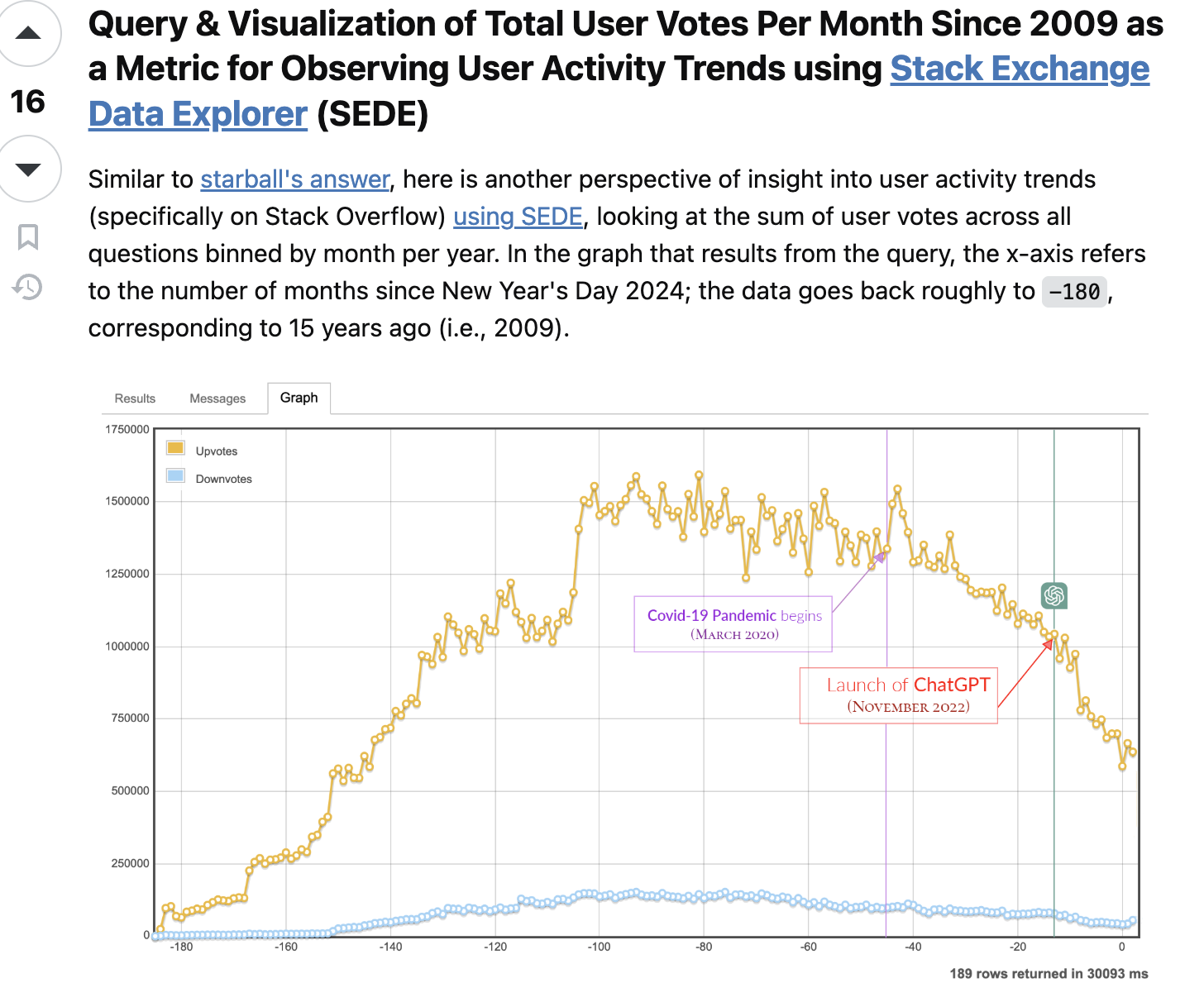
Source: StackExchange
Chasing rankings
Understandably, content creators (from whom Google derives its relevance – what would Google organise and rank if it had no free access to high-quality content?) cried foul.
CNN went as far as likening the launch of AI Overviews to the stroke of midnight on the Doomsday clock.
So the big question arises: if digital marketing aims to drive users to your online platforms, is there still any point in chasing top rankings on Google?
Search Engine Optimisation is still relevant
Brands must remain visible on search platforms. ChatGPT might give information, but it cannot direct you to buy a specific item in your local area. Nor can it make a booking for a nearby service.
Absolutely. Despite the rise of AI-powered platforms, Google Search still receives around 373 times more queries than ChatGPT. This shows that search engines remain the primary way people discover information.
– Koketso Mulatedzi, Digital Advertising Specialist at Flow Communications
That said, search professionals are cautioned to update their toolkits. The search landscape has changed, and professionals must adapt accordingly.
How to optimise for this new search reality
As long as people use search engines, businesses will need to apply Search Engine Optimisation strategies.
Here are some tips for staying visible in today’s evolving search environment:
-
Stick to Search Engine Optimisation fundamentals
Google has not changed how it judges content quality. The search engine still relies on four key signals:
-
- Experience – Does your content reflect first-hand knowledge of the subject?
- Expertise – Do you have deep understanding of the topic?
- Authoritativeness – Are you recognised as a reliable voice in the field?
- Trustworthiness – Do others trust and reference your work?
If your site already performs well on Google, these next tips can help you optimise further.
-
Rethink keywords
AI tools have changed user search habits. People now enter full questions, not just keywords. This shift means Search Engine Optimisation must evolve. You must now identify and address complex questions that your target audience might ask about your product or service.
Third-party platforms like Semrush now include tools to track your site’s visibility in AI Overviews. Use them.
-
Adjust content structure
AI Overviews favour clear, direct answers. These are often pulled straight from structured content. Long, narrative-rich articles are less likely to be selected by AI.
This does not mean writing dull, bot-friendly content. Instead, it means reordering your copy to place a clear question and answer at the top. This satisfies the AI’s need for precision and increases your chances of being featured.
-
The bottom line – don’t panic
The tech industry has spent two decades celebrating “disruption.” As a result, people tend to predict catastrophe with each new shift. Will AI search really destroy content creation by cutting off website traffic?
Some say this fear is overblown. Google insists that AI Overviews will eventually drive more traffic to sites. Time will tell.
In conclusion
For now, developers and Search Engine Optimisation specialists should stay focused. They need to explore new tools, test what works, and stick to the core principles that define effective digital work: be agile, measure everything and optimise continuously. Search Engine Optimisation is not dead. In fact, it’s more important than ever.
Richard Frank | CTO | Flow Communications | mail me |