





Dominic Goncalves | Advisory Partner | Energy Strategy | Cresco Project Finance | Founder | Director | Naviara Energy | mail me |
South Africa faces two main energy security risks: electricity reliability and diesel dependency. The Strait of Hormuz crisis has shown a critical shift. Diesel is no longer a guaranteed “last line of defence”.
If an external shock, such as the Strait of Hormuz closure, occurred during load-shedding, pressure would rise sharply. Diesel availability would tighten. This would affect on-site generators for critical loads such as hospitals and data centres. It would also impact industrial, commercial, agricultural and residential consumers. These groups rely on backup power during outages. This scenario highlights the risks of diesel dependency under combined shocks.
Converging energy crises
Diesel has historically served as the last line of defence for power systems. This applies globally and in South Africa. Its reliability and availability made it indispensable. Despite its high cost, organisations consistently relied on it. Its availability was rarely questioned. However, the Strait of Hormuz crisis has changed that perception. It has exposed an energy security risk at both the fuel level and the on-site backup level. As a result, diesel dependency has become a central concern.
South Africa has experienced three severe load-shedding crises: 2008-2009, 2014-2015, and 2022-2023. The country now faces a global fuel supply crisis from February to April 2026. What would happen if these crises occurred simultaneously? What would cause Eskom to return to load-shedding while the Hormuz disruption continues?
Firstly, it is important to note that Eskom’s reserve margin remains stable. However, forecasts show risk ahead. Within the next three to four years, South Africa may return to load-shedding. This will occur if Eskom follows its decommissioning schedule. That schedule removes nearly half of its ageing coal fleet. At the same time, replacement capacity remains insufficient.
Technologies such as LNG, coal, nuclear, BESS and grid-forming inverters have not scaled adequately. Our National Energy Balance model predicts a widening system imbalance. Deficits will occur during early mornings and evenings. Consequently, Eskom will increase diesel usage. It will use diesel to follow renewable load patterns. However, renewables are being deployed without enough batteries or grid-forming inverters. This creates excess supply at certain times and shortages at others. Seasonal factors such as winter, cloud cover, and low wind worsen this imbalance.
Rising diesel demand and structural risk
During the load-shedding period of the 2024 financial year, Eskom’s diesel bill reached R26.6 billion. It used diesel to fuel OCGT peaker plants. These plants generated 3,634GWh of electricity. This helped avoid more severe load-shedding.
Since then, Eskom’s diesel consumption has dropped by 68%. It has shifted from emergency usage to intermittent peaking and balancing. However, this does not remove risk. Instead, it reflects ongoing exposure to diesel dependency.
As of March 2026, only two of five local diesel refineries remain operational. In addition, around 57% of South Africa’s refined diesel supply moves through the Strait of Hormuz.
Since 2022, South Africa’s domestic diesel refining capacity has halved. The shutdown of SAPREF and ENREF has changed the market structure. South Africa has shifted from relative self-sufficiency to import dependence. Currently, 70-75% of diesel is imported. This exposes the country to global market shocks.
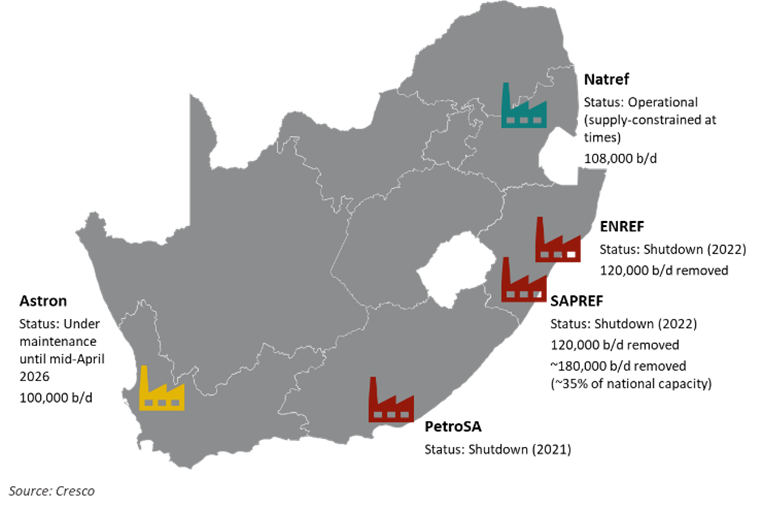
Between 2022 and 2026, local refining capacity stabilised at about 50% of pre-2020 levels. Over six years, South Africa lost its production role. As a result, price risks and availability risks have increased. Resilience has declined. This reinforces the structural challenge of diesel dependency.

Global supply pressures
More than half of South Africa’s diesel imports come from Gulf suppliers. These include Oman (34%), UAE (12%) and Bahrain (11%). Additional supply comes indirectly via India (20%). All these routes face exposure to Hormuz disruption.
Currently, as the Strait of Hormuz disruption reaches its sixth week, South Africa must compete for alternative supply. It competes with stronger buyers such as Asia and Europe. India acts as a swing supplier. It reallocates supply to the highest-paying markets.
Although South Africa has not declared a national diesel shortage, pressures are evident. These include pricing shocks, logistics disruption and localised shortages. A key variable remains uncertain. What would happen if an internal shock occurs alongside the current external shock? For example, what happens if load-shedding returns during the Hormuz disruption?
Diesel consumption dynamics
It is important to understand the consumer split of diesel consumption in South Africa. During stable periods, Eskom uses only 3-10% of the country’s diesel supply. It uses this for load-following and system balancing at four OCGT peaker plants.
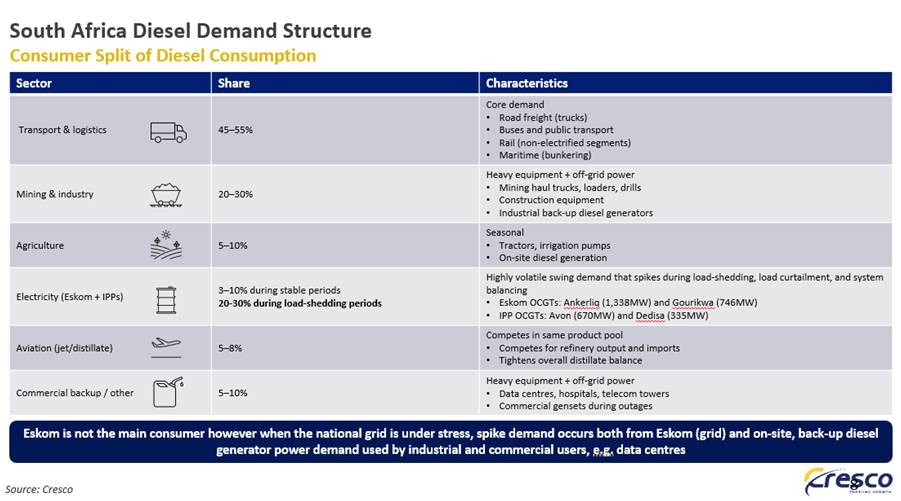
During load-shedding periods, this percentage increases significantly. It rises to between 20% and 30%. At the same time, private consumers increase their diesel usage. These include industrial, commercial, agricultural and residential users. They rely on diesel generators for backup power.
This means that any deterioration in Eskom’s performance could trigger a sharp increase in demand. National diesel demand could rise by more than 20-30%. This would occur in an already strained import environment. This dynamic intensifies the risks linked to diesel dependency.
Eskom’s current system status
Eskom is maintaining a relatively stable grid. This is notable given its ageing fleet of assets. However, 17.7GW of coal capacity is scheduled for decommissioning by 2035. This represents about 40% of South Africa’s grid.
Replacement generation remains insufficient:
- Currently, all main metrics used to assess system health remain stable. These include EAF, PCLF and UCLF.
- EAF has remained above 60% over the last eight months. UCLF has remained around 20%.
- UCLF refers to the unplanned capacity loss factor. It measures capacity offline due to unplanned outages.
- In Q1 2026, Eskom had 8.2-10.2GW of capacity offline.
- Load-shedding risk typically emerges when around 15GW of capacity is offline. This means Eskom currently has about 4.8GW of headroom.

Source: Cresco, Eskom, NTCSA

Source: Cresco, Eskom, NTCSA
What would it take to erode this 4.8GW headroom? What would trigger a return to load-shedding?
We evaluated two stress test scenarios at a concept level:
- Multiple Coal Unit Trips + Delayed Recovery.
- Minor Coal Unit Trips + Diesel / OCGT Constraint
Background to the stress test scenarios:
- Multiple unit trips at Eskom’s ageing coal plants are not uncommon.
- On 22 February 2025, five units at Majuba tripped. This removed more than 3GW of capacity.
- The resulting frequency event triggered another trip at Medupi. This removed 800MW.
- The total unplanned loss reached 3,800MW. This triggered Stage 3 load-shedding.
- An unrelated incident at Camden then caused four additional unit losses. This resulted from a hydraulic valve failure.
- In total, ten units were offline due to unplanned events.
- Load-shedding escalated to Stage 6 from 22 to 26 February.
- During these four days, some consumers experienced outages of six hours per day.
- On-site diesel backup would need to support such scenarios in 2026. However, supply risks are now higher. Prices are also elevated due to the Hormuz crisis.
- Any diesel shortage during such an event could limit generator use. This would affect multiple sectors. This risk underscores the vulnerability created by diesel dependency.
Scenario 1 – multiple coal Unit trips + delayed recovery
What would it take to return to load-shedding from the current stable system? We analysed a scenario where several coal units trip within one to three days. Additional failures occur at other units. These include boiler tube leaks, conveyor issues, coal quality problems or balance-of-plant constraints. These delays slow recovery.
An example escalation could include:
- 4-5 older 600 MW coal units trip or partially fail across weak assets, e.g. Tutuka, Kriel, Matla, Duvha, Lethabo or Kendal (2.4 – 3GW).
- 1 x large newer unit (800MW) at Kusile or Medupi has a full outage
- Boiler tube leaks/conveyor/coal quality / balance-of-plant constraints at 2-3 additional units (1.5-2.5GW).
The result is a combined loss of 4.5-6.5GW over several days. Reserve margins erode. Recovery slows. Capacity remains constrained across multiple peak periods. Pumped storage depletes. Diesel OCGT usage increases. If recovery does not occur, Eskom may implement Stage 1-2 load-shedding within four days.
Scenario 2 – minor coal unit trips + diesel / OCGT constraint
Cresco analysed a second scenario. In this case, moderate coal unit failures combine with diesel constraints. OCGT output becomes limited due to supply shortages or price shocks.
For example:
- Three to four 600MW units fail across weaker plants.
- Eskom cannot sustain OCGT output due to diesel constraints.
- Pumped storage depletes while renewable output remains weak.
The result is reduced flexible reserves. Diesel and hydro support both decline. The system cannot sustain peak demand over multiple days. Load-shedding follows. This scenario clearly illustrates the risks of diesel dependency.
Key takeaways
In the near term, load-shedding remains unlikely but possible. In the long term, the probability increases. This is especially likely from 2029 onward.
The Strait of Hormuz crisis delivers a clear lesson. South Africa cannot rely entirely on diesel in the future. Geopolitical risks can disrupt supply chains. They can turn diesel into a scarce resource rather than a reliable fallback.
Renewable energy and battery systems offer a stronger long-term solution. High-penetration microgrids provide resilience against fuel shocks. These systems combine solar and batteries. They operate on-site and reduce diesel consumption for critical loads. By oversizing solar and batteries, microgrids can reduce diesel reliance by more than 90%.
Grid-forming inverters enhance resilience. They enable blackstart and islanding capability. This ensures seamless transitions during outages. It also reduces the need for diesel generators. As a result, organisations require less on-site fuel storage. They face lower logistics risks. They also reduce exposure to diesel price volatility.
At a national level, South Africa must scale BESS deployment. This will reduce reliance on diesel during peak demand periods. Currently, renewable expansion is not supported by sufficient storage capacity. At a commercial, industrial and agricultural level, businesses classified as critical loads should invest in microgrids. This investment will likely deliver value over the next 20 years. It will also provide resilience against load-shedding and global fuel disruptions.