





Robert Koen | Managing Director | Amazon sub-Saharan Africa | mail me |
We have released our Small Business Digital Adoption Report. Independent research organisation World Wide Worx conducted the study.
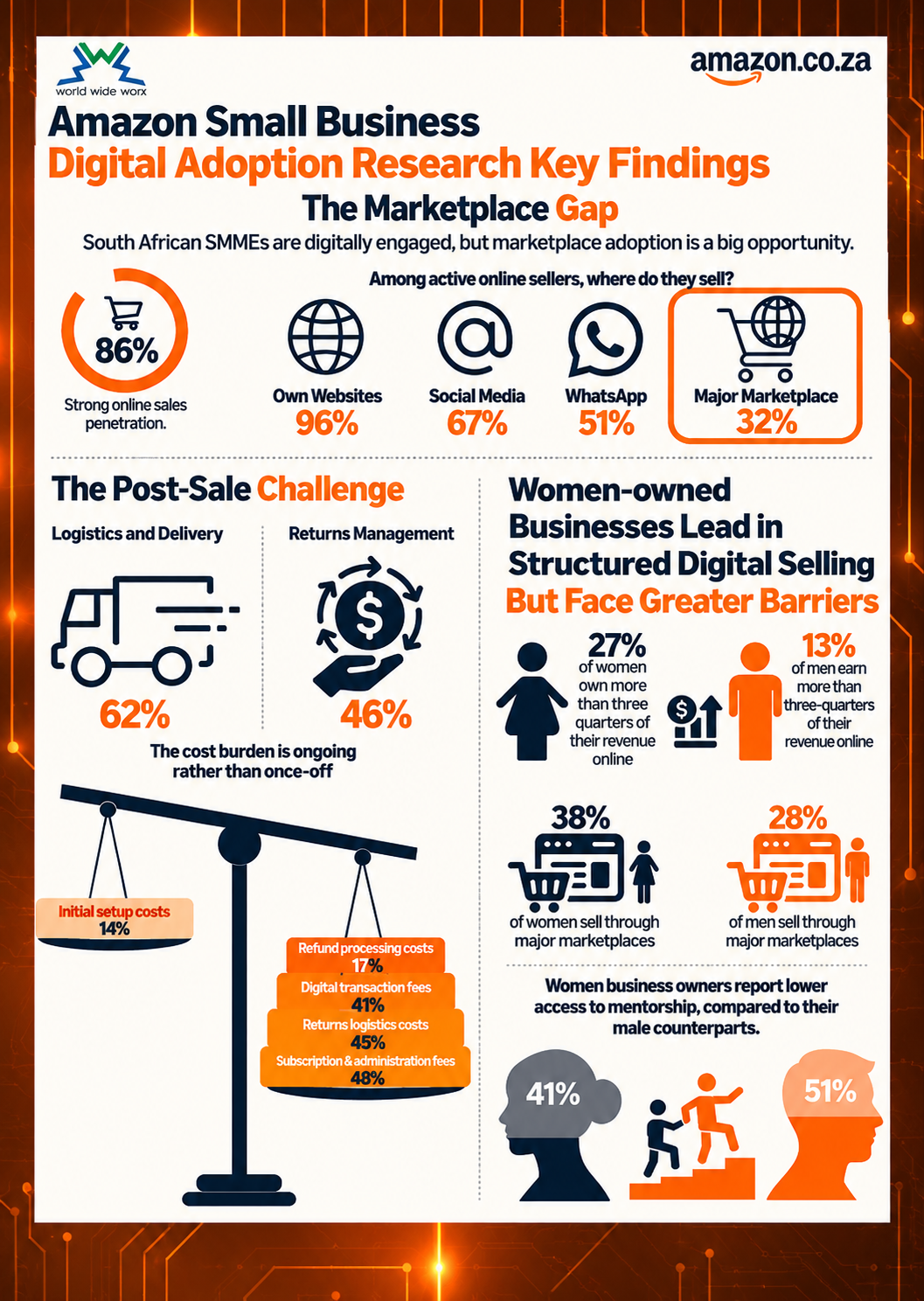
The study reveals that 99.6% of urban, digitally active South African Small and Medium Enterprises (SMEs) surveyed use the internet for business. Furthermore, 86% generate online sales. However, only 32% of active online sellers use a major marketplace. This highlights a substantial gap between digital readiness and marketplace participation.
This research tells me a clear story. South African small businesses are ambitious, digitally capable and ready to grow. However, logistics complexity, rising costs and limited access to support continue to hold them back. We recognise this as a direct mandate. Every investment we make in our marketplace addresses these barriers. This includes fulfilment infrastructure and AI-powered seller tools. Our goal is to turn these challenges into opportunities for small businesses across the country.
The 2026 report surveyed 1,400 South African SMEs. It examined how businesses establish a digital presence, sell online, select channels and experience operational pressures. It also explored their use of AI. The findings indicate that connectivity and payments present fewer challenges for this largely established, urban and digitally active sample. Instead, logistics and fulfilment lead the pressures associated with online selling. Meanwhile, recurring costs remain a separate barrier to digital adoption.
The marketplace gap
Among the 86% of active online sellers, 96% sell through their own websites. Meanwhile, 67% use social media and 51% use WhatsApp. However, just 32% sell through a major online marketplace listing.
The research identifies a clear perception barrier. Some 21% of all respondents believe their businesses are too small to qualify. This represents a misconception rather than a commercial reality. Furthermore, 39% cite application requirements or fees as deterrents.
These findings suggest that marketplace recruitment needs a different approach. We should not focus on convincing businesses to sell online for the first time. Instead, we need to show existing digital sellers what a marketplace can add to their channel mix. More importantly, we must demonstrate how it can drive significant growth.
South African SMEs have already proven they can sell online. The question is no longer whether they are digital, but how they can grow beyond their own operational limitations. The data shows a large, commercially active population of online sellers that are ready for the next step, but need clearer pathways, simpler onboarding, and practical support to get there.
– Arthur Goldstuck, CEO at World Wide Worx
The real challenge begins after the sale
Our study highlights a decisive shift in what holds South African SMEs back. Among active online sellers, 62% identify logistics and delivery as their biggest challenge. Returns management follows at 46%. By contrast, payment systems account for just 12%, while connectivity accounts for 5%. These factors no longer represent significant barriers.
The financial burden also extends beyond initial investment. Recurring costs dominate the financial barriers. Some 48% cite ongoing subscription or administration fees. Another 41% identify digital transaction fees, while 14% cite initial setup costs.
These findings reinforce what we hear from sellers every day. The hard part is not getting online. Instead, it is managing everything that happens after a customer clicks ‘buy’.
Whether through reliable delivery, streamlined returns management or Artificial Intelligence (AI) tools that simplify listing creation, South African SMEs need an infrastructure that can help them compete and scale. As SMEs have gone digital, we must also help them manage the operational demands that accompany online growth.
Women-owned businesses lead in structured digital selling
The research reveals that women-owned businesses are twice as likely as male-owned businesses to operate online-first. Some 27% of women-owned businesses earn more than three-quarters of their revenue online. By comparison, only 13% of their male counterparts achieve the same proportion.
The findings also show that women entrepreneurs are more likely to sell through a major marketplace. Their participation stands at 38%, compared with 28% for male-owned businesses.
However, women business owners report lower access to mentorship. Only 41% report access, compared with 51% of their male counterparts. This highlights a gap between their marketplace readiness and the support available to them.
Women-owned businesses are already demonstrating the behaviours that lead to marketplace success. They sell online, they adopt structured programmes, and they use AI marketing tools at higher rates. But the data also tells us they need more support, particularly around mentorship and managing costs. We see this as both a responsibility and an opportunity to build targeted programmes that help women entrepreneurs thrive on our marketplace.
– Suzelle Abe, Head of Marketplace at Amazon South Africa
As SMEs have gone digital, we must ensure that women entrepreneurs can access the resources and support needed to sustain their progress. Mentorship and targeted programmes will play an important role in helping them overcome remaining barriers.
AI adoption is widespread but shallow
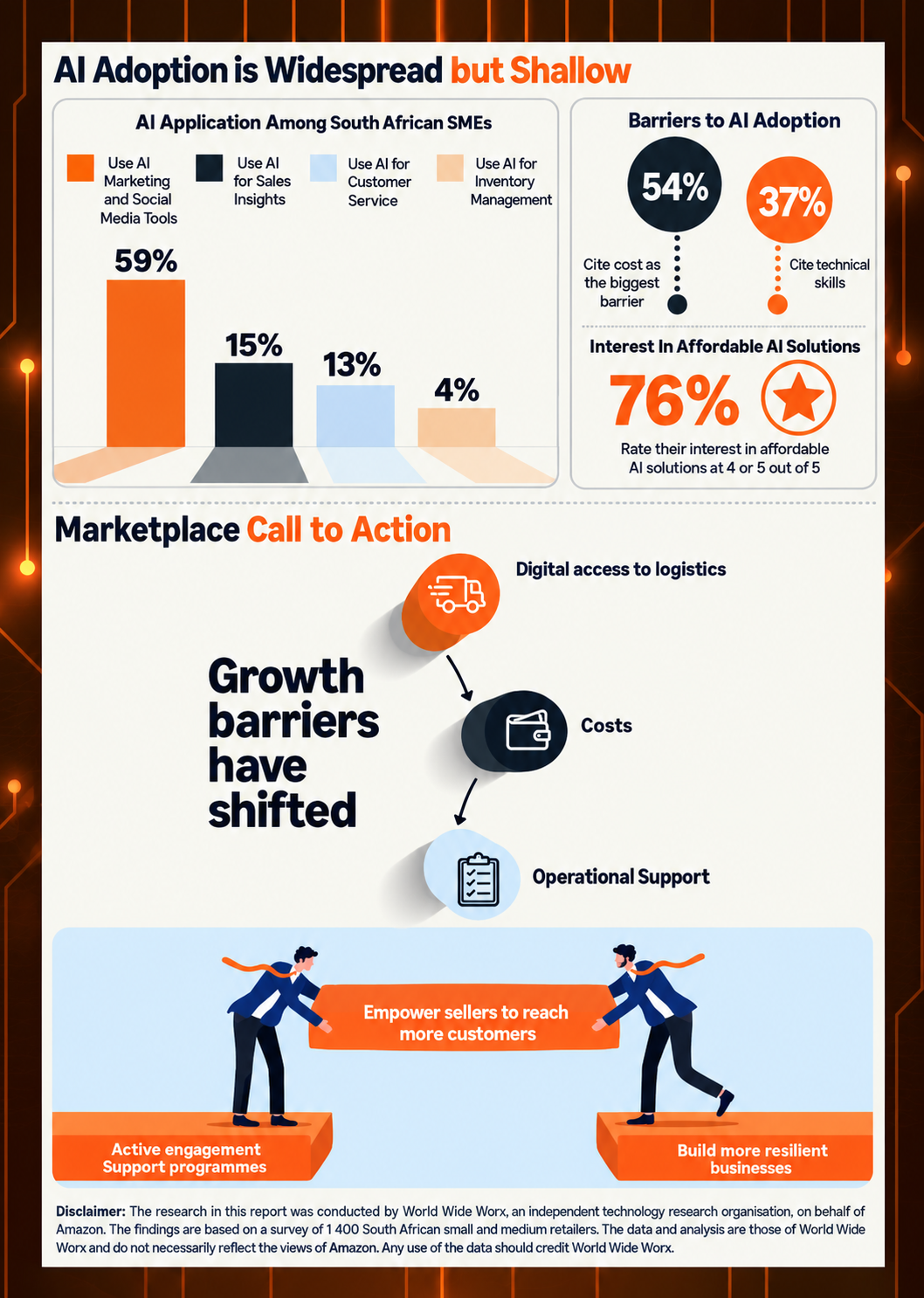
AI adoption among the SMEs surveyed remains concentrated primarily in marketing. Some 59% of businesses use AI marketing and social media tools. However, deeper operational applications remain limited.
Only 15% use AI for sales insights, while 13% apply it to customer service. Even fewer, just 4%, use AI for inventory management. Cost represents the biggest barrier, with 54% identifying it as a challenge. Technical skills follow at 37%. Despite these obstacles, interest in affordable AI solutions remains strong. In fact, 76% of businesses rate their interest at four or five out of five.
This finding aligns with our investment in AI-powered seller tools. These include our Generative AI listing builder and automated product description generator. Both tools help sellers create optimised product listings from minimal input. Consequently, they reduce the time, cost and skills required for professional digital selling.
These tools also empower small and medium-sized businesses to compete globally. They automate several processes, including product listings, translations, inventory management and marketing content creation.
As SMEs have gone digital, AI presents another opportunity to improve their competitiveness. However, we must make these technologies accessible and practical. Businesses need affordable solutions that address their everyday operational challenges.
Marketplace opportunity
The research findings point to a mature local SME e-commerce sector. However, participation in major online marketplaces remains limited. Growth barriers have also shifted. Digital access is no longer the primary challenge. Instead, logistics, costs and operational support now require greater attention.
This presents a clear opportunity for South African marketplaces. We can bridge the gap through active engagement and targeted support programmes. These initiatives must meet sellers where they are and empower them to reach more customers. Ultimately, we want to help businesses build more resilient operations.
The findings confirm that SMEs have gone digital and are ready for the next stage of growth. Our responsibility is to help them navigate the remaining barriers. Through marketplace infrastructure, fulfilment services, AI-powered tools and practical support, we can help more South African businesses compete and scale.