





The US-Iran war and the closure of the Strait of Hormuz weighed on the global economy in the second quarter of 2026. Higher energy prices pushed global inflation higher. Consequently, some markets adopted a more hawkish monetary policy stance.
The operating environment in South Africa (SA) during the first half of 2026 was mixed. Real GDP growth in the first quarter surprised on the upside. Meanwhile, higher fuel prices drove local consumer inflation up from a low of 3% in February. In response, the South African Reserve Bank (SARB)’s Monetary Policy Committee increased interest rates by 25 bps in May.
This took the prime lending rate up to 10.5%. Industry credit growth strengthened modestly. Corporate credit growth accelerated off a low base, while household credit growth improved gradually. However, affordability pressures continued to constrain household credit growth.
Economic outlook and financial performance
SA’s economic outlook continues to show encouraging signs of improvement. This progress reflects a more credible fiscal trajectory, advances in structural reforms, and recent credit rating upgrades. Despite global uncertainties and the conflict in the Middle East, many of the country’s positive prospects as an attractive investment destination remain intact.
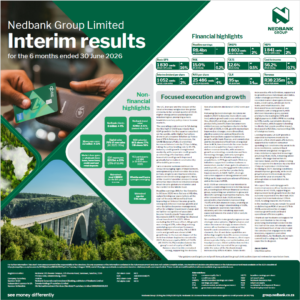
The Nedbank unaudited interim financial results show that Headline Earnings (HE) for the six months to 30 June 2026 remained flat year on year at R8.4 billion. This performance exceeded our expectations at the start of the year.
Improving net interest income growth, strong non-interest revenue growth and disciplined expense management supported HE. However, a higher impairment charge and no further recognition of associate income from Ecobank Transnational Incorporated (ETI) offset these benefits. The bank ceased recognising ETI associate income after disposing of its investment in 2025. Excluding the ETI base effect, HE growth reached a strong 12%. This reflected a strong underlying operational performance.
Diluted HEPS increased by 2% to 1 803 cents. Growth exceeded HE growth because of the run-rate impact of the well-timed share buybacks executed in 2025. Return on equity (ROE) reached 15.0% (H1 2025: 15.2%). This remained above the group’s cost of equity of 14.0%. Balance sheet metrics also remained strong. As a result, the group declared an interim dividend of 1 052 cents per share.
Strategic execution and cluster performance
Following the bold strategic decisions the Nedbank Group made in 2025, benefits have become more evident across its business clusters during the first half of 2026. These decisions aimed to become more client-centred, unlock growth and cross-sell opportunities, diversify earnings, and enhance productivity.
In CIB, growth momentum improved. Stronger and more diversified pipeline conversion supported advanced growth. Participation in larger transactions also contributed to this performance. Meanwhile, trade finance, commission and fee income benefited from strong deal flow. In BCB, investments in the new cluster and recent acquisitions have started to deliver revenue benefits. Advances in growth accelerated, while commission and fees increased strongly. Early synergies also emerged from the iKhokha and Eqstra acquisitions.
In PPB, growth and efficiency initiatives supported continued advances in momentum. They also supported market share gains in advances and deposits, very strong growth in insurance and payments, and further productivity improvements. In NAR: SADC, strategic execution supported strong advances and NIR growth. It also improved operational efficiency and increased ROE.
In Q1 2026, the group announced its intention to acquire a controlling interest in NCBA Group plc. NCBA is a leading East African financial services group. The acquisition supports the group’s ambition to grow and diversify earnings in attractive markets. The offer closed on 10 July 2026. Shareholders representing 79.9% of the NCBA shares in issue accepted the offer. This enabled the Nedbank Group to achieve its targeted 66% shareholding. The group have obtained key regulatory approvals. They expect the remaining approvals towards the end of Q3 or early in Q4 of 2026.
Strategic value unlocks and digital growth
Nedbank continued to make good progress on its strategic value unlocks. Digital volumes and values increased strongly as more clients across all its businesses embraced the benefits and convenience of digital channels. The group’s Artificial Intelligence (AI) and data capabilities are delivering tangible benefits across revenue generation, credit effectiveness, client experiences, productivity, cost optimisation, and fraud processes.
Client satisfaction metrics remained at the top end of the peer group. Meanwhile, the value of the Nedbank brand increased by 16% to R24 billion. Total clients increased by 4% to 8 million. Growth across individuals and SMEs supported this increase.
Under strategic portfolio tilt, Nedbank recorded market share gains in home loans, credit cards, wholesale term loans, and retail deposits. The increased focus on insurance and payments also generated strong growth. MyCover insurance gross earned premiums increased by 23%. Digital payments NIR in PPB increased by 15%.
Lastly, lending to clients that creates lasting positive impacts, sustainable development finance, increased to R213 billion. This represented 21% of total gross loans. These results further demonstrate the progress reflected in the Nedbank unaudited interim financial results and the benefits of our strategic value unlocks.
Outlook for the second half of 2026
Looking forward, SA GDP growth is expected to improve modestly to around 1.3% in 2026 and 1.4% in 2027. Resilient consumer spending should support this growth. However, weak business confidence, subdued fixed investment and global energy price risks will constrain the outlook.
Inflation is expected to average around 4.0% in 2026. This would remain above SARB’s 3% target but within its tolerance band. The prime lending rate is expected to increase by a further 25 bps in September 2026 before declining in 2027.
Banking conditions should improve gradually. Credit growth is projected to remain positive and end the year at around 7%. However, risks remain tilted to the downside. The Nedbank Group expects the underlying growth momentum across all our businesses to continue in H2 2026. This should support an improvement in HE growth from the flat outcome reported in the first half.
ROE is expected to remain above 15% in 2026, heading towards 2025 levels. In the medium term, the group remains focused on delivering an ROE of around 17% in 2028. Stronger revenue growth and continued operational efficiency gains will underpin this objective.
Commitment to clients and stakeholders
The Nedbank unaudited interim financial results demonstrate strong underlying momentum despite a challenging operating environment. They also reflect the progress achieved through our strategic priorities, digital investments and disciplined cost management.
I thank all our Nedbank colleagues for their contribution to the strong underlying momentum evident in the first half of the year. We deeply value the continued trust of our clients and the constructive engagements with investors, regulators and other stakeholders. As Nedbank, we remain committed to using our financial expertise to do good.
– Jason Quinn, Chief Executive
THE INTERIM FINANCIAL RESULTS