




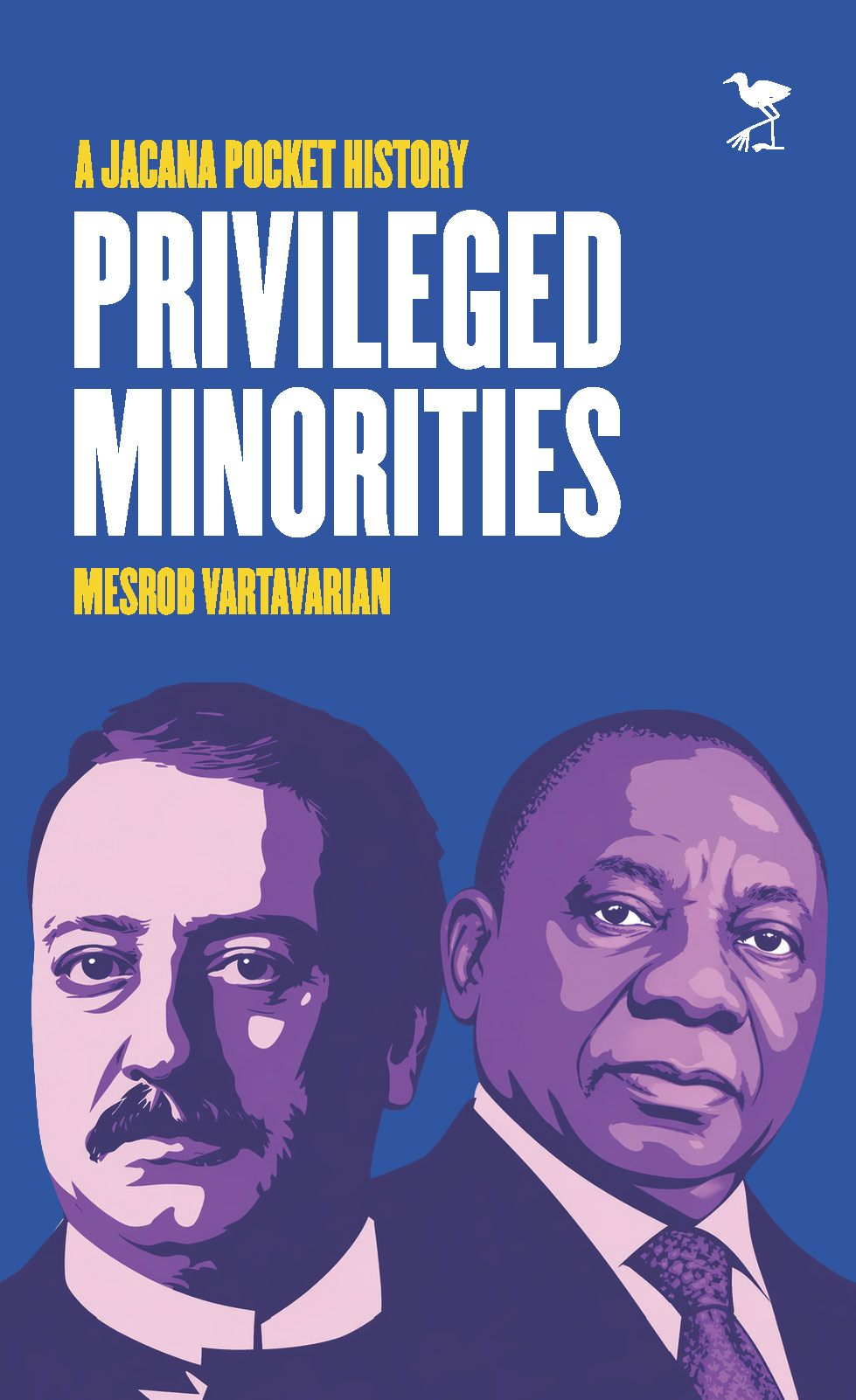
A History of Wealth Concentration in South Africa – A Jacana Pocket History
By Mersrob Vartavarian
How do structural advantages persist and evolve, even in the wake of liberation?
How does a country shaped by anticolonial struggle become fertile ground for wealth concentration alongside enduring inequality?
Paradox of liberation and inequality
South Africa holds one of the strongest constitutions globally. At the same time, it remains one of the most unequal societies in the world. Mesrob Vartavarian’s Privileged Minorities examines this paradox. The work offers a detailed and timely historiography. It directly engages the dynamics that sustain inequality.
South Africa has one of the best constitutions in the world. However, it also remains one of the most unequal societies in the world. The book addresses this central contradiction. The book shows how privileged minorities continue to shape economic outcomes across historical periods.
Vartavarian argues that privileged minorities emerged alongside successful anticolonial movements. These privileged minorities consist of small, exclusive groups. They dominate both political and economic life.
These groups secure exclusive advantages. These advantages include land seizures and racialised labour systems. They also include access to coercive institutions and favourable regulatory environments. In addition, targeted state expenditure strengthens their position.
These mechanisms drive economic growth. However, Privileged Minorities capture most of the benefits. Oligarchies and middle-class groups benefit disproportionately from this structure.
Historical continuity of structural advantage
The book traces how sociocultural groups navigated these advantages across South African history. This analysis spans the Dutch colonial era. It also covers the rise and decline of the African National Congress rule.
Privileged Minorities did not disappear through the political transition. Instead, challenges from marginalised groups reshaped these systems. New actors entered existing structures without dismantling them.
These processes produced composite systems of accumulation. Privileged Minorities adapted within these systems. Inequality persisted through continuous reconfiguration rather than disruption.
Elites, accumulation and institutional continuity
Through this historical lens, Privileged Minorities offers a framework for understanding structural persistence. It explains how advantage evolves across political change. It also explains how liberation does not automatically dismantle inherited systems.
Most Black political elites strove to emulate the material culture of their white oppressors. Acquisition of prestige goods, rather than structural economic reform, absorbed their energies. This exposed them to corporate capture and the repurposing of revolutionary parties toward schemes of illicit accumulation.
About the author
Mesrob Vartavarian has published widely on elite formation and power structures in the Global South. He has held research fellowships at Cornell University, Harvard University, and the University of California, San Diego. Vartavarian also served in teaching roles at these institutions.
He now works as a consultant at the Global Initiative against Transnational Organised Crime. His scholarship on privileged minorities continues to shape debates on inequality and elite persistence.
- DISTRIBUTOR | Jacana Media |
- ISBN | 9781431437061 |
- Recommended Retail Price | R195.00 |
- Classification | History, Current Affairs |