




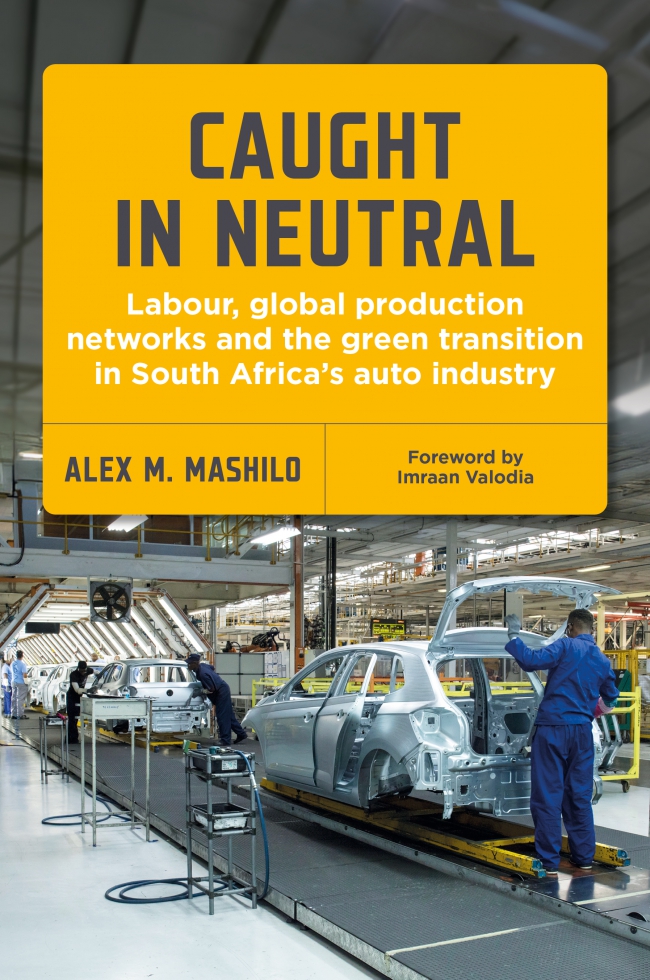
Labour, global production networks and the green transition in South Africa’s auto industry
By Alex Mohubetswane Mashilo
Caught in Neutral offers a timely and critical examination of South Africa’s automotive industry. Alex M Mashilo explores how global geopolitics, industrial policy and economic restructuring shape the sector’s future.
The author also questions whether current strategies adequately protect workers and communities during the transition to greener technologies.
Drawing on his experience as an automotive technician and trade-union leader, Mashilo connects industrial development with workers’ rights and economic justice. The book examines how multinational corporations pursue profitability through technological innovation and control of global production networks. However, economic growth does not automatically improve workers’ wages, conditions or livelihoods.
Rethinking industrial policy and workers’ rights
One of the book’s central arguments concerns the disconnect between economic and social upgrading. While corporations capture the benefits of increased productivity, workers and communities often absorb the costs of restructuring and decarbonisation. Mashilo argues that South Africa needs deliberate interventions to ensure that industrial transformation delivers meaningful social benefits.
Furthermore, Caught in Neutral exposes inconsistencies in South Africa’s industrial policy. It demonstrates how shifting policy priorities have weakened efforts to establish a worker-centred just transition. Nevertheless, Mashilo identifies transport as an important opportunity for organised labour and climate movements to develop a shared transformative agenda.
The book encourages readers to reconsider the relationship between industrial competitiveness, environmental sustainability and social protection. It also highlights the importance of strategic collaboration between government, business, trade unions and civil society. These perspectives make Caught in Neutral particularly relevant as the automotive industry navigates electrification, technological change and evolving global supply chains.
Overall, this is a valuable contribution to discussions about South Africa’s industrial future. It challenges policymakers and industry stakeholders to place workers and communities at the centre of economic transformation. It also offers important perspectives for anyone interested in labour relations, industrial development and climate justice.
About the author
Alex Mohubetswane Mashilo is a Visiting Researcher at the Southern Centre for Inequality Studies at the University of the Witwatersrand. A former automotive apprentice and technician, he also served as a NUMSA shop steward and national official. His extensive experience spans collective bargaining, industrial policy and labour relations.