






John Loos | Independent Economist | John Loos Economics | mail me |
Housing market data has shown a broad rise in the house price/rent ratio over some years. This trend would point to relative affordability shifting in favour of the rental option over buying. However, there is far more to consider in the “rent vs buy” debate.
We recently saw the release of StatsSA’s House Price Indices for December 2025. This release completed the house price performance picture for last year.
House price growth exceeds rental growth
The national house price index rose by 7,5% year-on-year in December. This marked a further acceleration from the 7,2% rate recorded in the prior month.
By comparison, StatsSA’s Residential Rental CPI (Consumer Price Index) has also followed a broad acceleration path. However, it only reached 3,21% year-on-year growth by the end of 2025 and 3,70% by March 2026. This implies a significantly slower pace of increase than house prices.
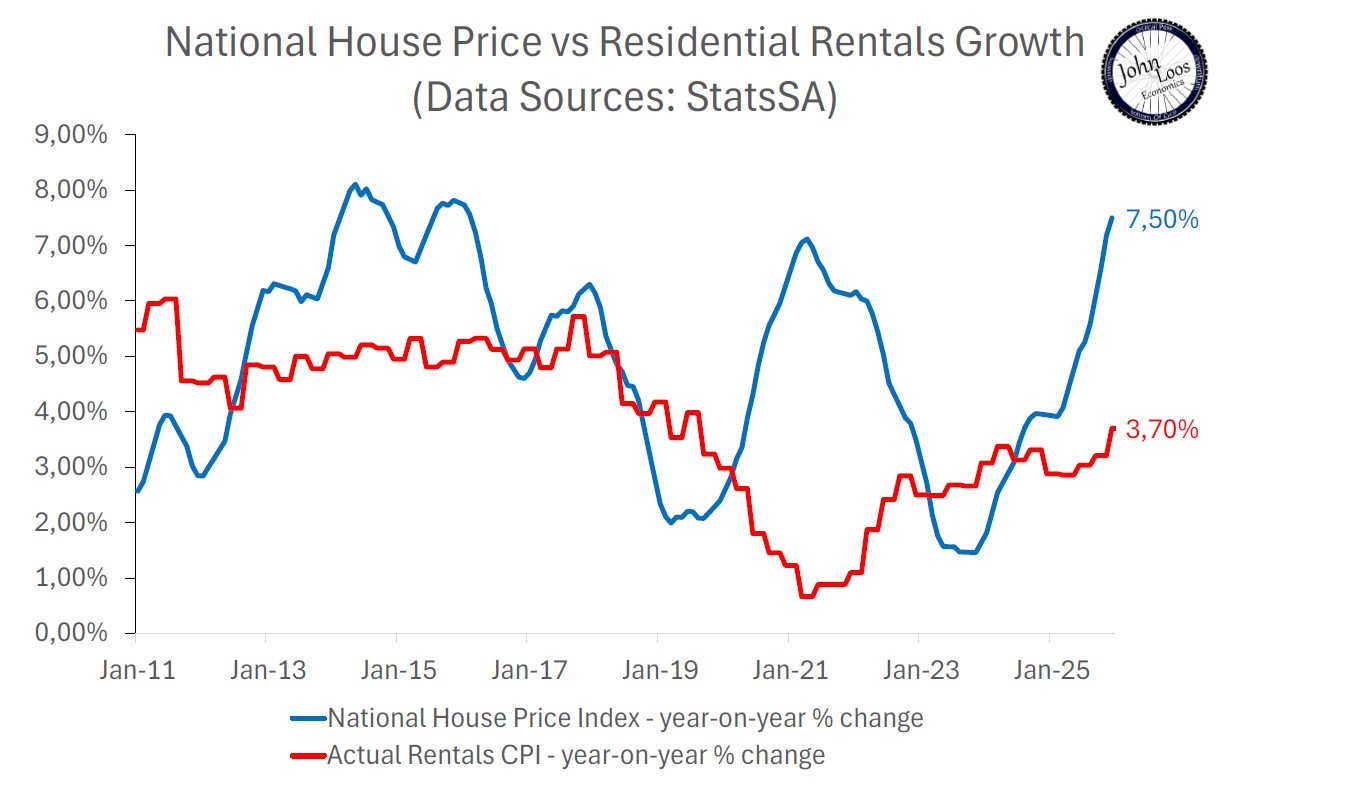
In fact, for much of the period from 2010 to 2025, average rental increases did not keep up with average house price increases. Simplistically, this would imply a deterioration in home-buying affordability relative to the rental option. It would also appear to support renting over home buying in the broader rent vs buy discussion.
But is it really that simple?
The home price-rent ratio has been rising
The graph below plots two important measures relating to “rent vs buy” relative affordability. The first measure is a simple Average Home Price/Average Home Rental Ratio Index. It uses January 2010 as a base month with an index value of 100. The index exists in this format because both StatsSA’s home price and rental data appear in index form.
The average house price-to-average rental index has shown a broad rising trend since 2010. By December 2025, the index stood 16,5% above the January 2010 level. This implies a deterioration in the affordability of home buying relative to renting when one simply compares house prices with rentals. However, the cost of credit also matters greatly for many credit-dependent aspiring home buyers. Therefore, the second index depicts the bond instalment on a new loan on the average-priced home at the prime rate, relative to the average rental ratio index.
This second index is far more cyclical than the price-to-rental index. Interest rate fluctuations move it significantly. Nevertheless, it also shows a broadly deteriorated home price/rent ratio as of December 2025 compared with January 2010. It stood 14,6% higher at the end of last year. Recent interest rate cuts did reduce it from a 2024 high.

Is renting becoming a better option than home buying?
Does this mean the rental option is better than home buying? Not at all. These index trends merely suggest a deterioration in home-buying affordability relative to the rental option between 2010 and 2025. Rent vs buy financial calculations can prove useful. However, they also have shortcomings.
This trend could conceivably mean that, from a simple rands-and-cents perspective, renting may have become the better option in more cases. However, this certainly does not apply to all cases.
The rent vs buy decision remains far more complex than a simple set of financial comparisons. Some people perform calculations to prove the superiority of either renting or buying. They typically tally all the costs of buying, including transaction-related costs, operating costs, maintenance costs, and debt-servicing costs. They then compare those costs with the total return on the property, including capital growth and income return. After that, they perform a similar exercise for the rental option.
When arguing that renting creates cost savings relative to buying, these individuals typically assess the return they could have earned by investing those savings elsewhere. For instance, they may compare property investment returns with stock market returns.
Financial calculations have limitations
The first problem with these financial comparisons lies in the starting and finishing points. Timing becomes crucial when comparing investment performance between the property market and the stock market.
Different periods produce different outcomes depending on which market outperformed during that time. As the saying goes, if one tortures statistics long enough, they will confess. However, a second problem also exists with these financial calculations. In the real world, very few people consistently invest the money they save by renting instead of buying.
South Africa remains a low-saving society. Therefore, people often spend those savings on consumer purchases instead of investments that generate financial returns. As a result, even if a home investment does not outperform alternative investments, homeowners may still end up in a stronger position than they would have been through renting. Acquiring a home and taking on a home loan creates financial discipline because borrowers generally feel compelled to comply with loan agreements.
This discipline may otherwise not exist. Consequently, homeowners often end up with an asset worth a significant amount of money. That asset contributes meaningfully to their overall net wealth, assuming the surrounding area does not experience severe decay.
I would question how many tenants would have outperformed homeowners by consistently investing the potential savings achieved through not owning a home.
Rental offers flexibility and mobility
This does not mean the home rental option represents a bad idea.
On the contrary, it plays a very important role in the housing market:
- Home rental can work very well for households that need or prefer mobility. For example, someone who does not plan to remain in a town or area for a significant period may benefit more from renting. The same applies to individuals with uncertain work locations, such as project-based contractors. Given the high costs associated with home transactions, renting may prove far more beneficial than frequent buying and selling.
- Renting can also work well temporarily for people who are not yet financially strong enough to buy the home they ultimately want.
- Many homeowners who experience financial difficulty proactively sell their homes and downscale into the rental market. This allows them to reduce costs and rebuild financial stability.
- For people who lead busy lives, renting may offer greater convenience. Many tenants prefer not to deal with home maintenance or simply lack the time to do so.
- The rental option also protects tenants from many unexpected “wear and tear” maintenance costs that arise suddenly when appliances fail or leaks appear.
Home ownership can bring greater stability
Home rental occupies an important place within the housing market and within the broader rent vs buy conversation:
- Home ownership can become more appealing when households want long-term stability. Some people prefer to avoid the uncertainty and disruption that may arise when landlords choose not to renew leases. In addition, periodic relocation carries high costs. Many rent-option calculations fail to account fully for these expenses.
- Home ownership also allows occupants to renovate their properties according to their own preferences and lifestyles, subject to bylaws and complex rules. This freedom can significantly improve happiness and well-being, whereas rental arrangements often limit such opportunities.
- Home ownership can create a stronger sense of stability and permanence. Owners determine their own departure dates instead of relying on landlords. In addition, owners gradually build wealth as they pay off their properties. Under the right conditions, this can reduce stress and anxiety.
- Because society often views home ownership as important, it can also improve self-esteem.
The well-being impact of home ownership
Certain literature points to a positive relationship between home ownership and well-being. For example, Shams Rahman and David R. Steeb published a 2024 article in BMC Public Health titled “Unlocking the door to mental wellness: exploring the impact of homeownership on mental health issues”.
Their research assessed the relationship between home ownership and mental health. The evidence suggested that homeowners experienced lower rates of depressive disorders, fewer cognitive difficulties, and better mental health overall. However, under the wrong conditions, home ownership can negatively affect well-being.
When home ownership creates financial stress, or when the surrounding area experiences severe decline, ownership may not represent the best option. In some cases, it may even damage well-being.
Mental health and well-being issues can create long-term productivity and healthcare costs. Simplistic rent vs buy calculations often fail to account for these factors.
In conclusion
In short, no universally correct answer exists to the question of whether people should rent or buy. Both options fulfil important roles within the housing market, which explains why both continue to exist. However, people should not rely solely on simple rands-and-cents calculations when comparing home ownership with renting. They should also consider mobility versus stability, along with broader well-being considerations.
Ultimately, people do not only buy a financial investment when purchasing a home. They also buy into a lifestyle.