



Jene’ Palmer CA(SA) GCB.D | Director | CGF Research Institute | mail me |
A paradigm shift is necessary to ensure that shareholders, customers, employees and society benefit from good governance outcomes. The introduction of the King V Code on Corporate Governance for South Africa 2025 (King V) marks a clear turning point.
Governance no longer functions as a simple administrative task. Instead, King V emphasises outcomes-based performance, integrated thinking and the strategic governance of Data, Information and Technology (DIT). As a result, organisations must embrace a cultural and behavioural transformation. This transformation requires a stronger governance consciousness across every level of the organisation.
The core challenge – changing the why of governance
The real challenge for modern leadership extends beyond understanding governance principles. Leaders must also design environments where employees naturally act according to those principles.
A digitised governance infrastructure can serve as a strategic enabler for this shift. In doing so, it strengthens governance consciousness throughout the organisation. A “tick-box” mentality often emerges when employees view governance as an external obligation. In such cases, people see governance as a constraint on value creation. However, King V requires deeper commitment.
Leadership must therefore shift the narrative around governance. Employees and stakeholders should see good governance as the most effective pathway to sustainable business performance. Strengthening governance consciousness helps organisations achieve this shift.
The behavioural catalyst – from subjectivity to objectivity
Traditionally, organisations treat governance as an occasional compliance exercise. These exercises often rely on qualitative judgement and subjective interpretation.
Unfortunately, this approach allows teams to minimise accountability. Individuals may focus on managing perceptions instead of improving performance. However, organisations can transform governance by making it measurable, visible and performance-based.
This approach integrates governance directly into strategy and value creation. As a result, governance consciousness becomes part of everyday decision-making.
A digitised governance framework can accelerate this behavioural shift in several ways:
-
Establishing governance KPIs
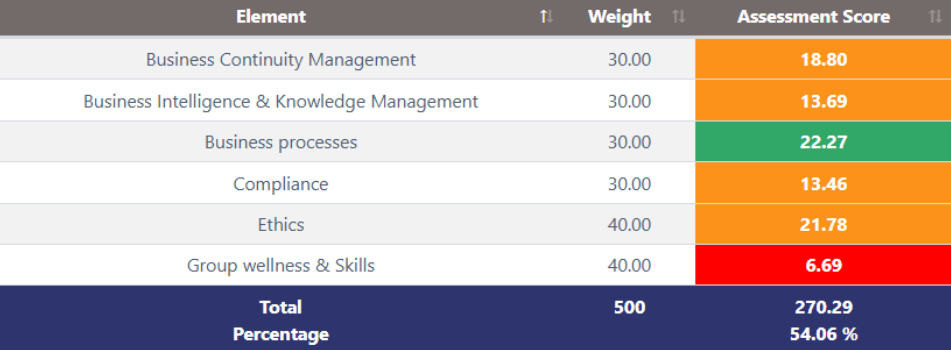
Organisations can establish governance KPIs. These indicators translate abstract governance principles into measurable metrics. For example, leaders can assess the effectiveness of business continuity plans. This approach encourages teams to demonstrate real governance outcomes. Instead of reporting activity, such as holding meetings, teams must show measurable improvement. For instance, they may demonstrate that monitoring and reviewing business resilience has improved by a measurable percentage.
Example of KPI scorecard
-
Creating a data-driven feedback loop
Organisations can create a data-driven feedback loop. A digitised system continuously evaluates performance against governance standards. Real-time visibility prevents governance issues from escalating. In addition, employees must adopt a proactive approach to governance. Instead of reacting to problems later, they can identify and resolve risks earlier. This shift reinforces governance consciousness throughout the organisation.
Consequently, the organisational mindset changes significantly. Teams move away from defensive compliance that simply avoids sanctions. Instead, they adopt performance ownership by managing measurable governance KPIs that influence business value.
Underpinning the foundational principles of governance
A digitised governance infrastructure strengthens governance because it embeds King V principles into everyday workflows. As a result, employees naturally follow behaviours that support strong governance practices.
Outcomes-based governance – the ethical implications of transparency
King V requires organisations to demonstrate outcomes in several areas. These include ethical culture, performance, control and legitimacy. A digitised governance framework strengthens these outcomes through structured and evidence-based reporting. This approach introduces a powerful ethical principle: transparency.
First, transparency elevates ethical culture. Objective data reveals how closely employees follow policies and governance best practices. Consequently, organisations reduce ambiguity and prevent attempts to conceal poor behaviour.
Second, transparency strengthens accountability. Governing bodies and stakeholders gain access to measurable insights into governance performance. These insights highlight both strengths and weaknesses.
As a result, leaders must take ownership of governance outcomes. This responsibility encourages moral courage and organisational honesty. At the same time, transparent governance systems strengthen governance consciousness across teams.
When organisations deploy a digitised governance framework, employees understand that governance performance remains visible. Governance operates under an objective spotlight. Therefore, ethical and effective behaviour becomes a required part of every employee’s contribution. This dynamic reinforces governance consciousness throughout the organisation.
Integrated thinking – connecting decisions to value
Integrated thinking, outlined in Principle 3 of King V, requires leaders to recognise interdependencies across organisational resources. Leaders must understand how decisions affect these interconnected capitals.
A digitised governance framework encourages this holistic perspective. The framework integrates governance performance data with financial, social and environmental metrics.
When decision-makers review projects or allocate resources, they can assess proposals within a broader context. They can also consider implications for stakeholders and the environment. In addition, governance performance assessments encourage collaboration across departments.
The system often triggers discussions between divisions and functions. As a result, organisations strengthen coordination and strategic alignment. Decision-making becomes more cohesive and consistent with organisational purpose. This collaborative process further reinforces governance consciousness across teams.
Strategic governance of DIT – the new consciousness
King V’s Principle 10 recognises DIT as a strategic organisational asset. These assets require dedicated governance structures. A digitised governance framework naturally supports this principle.
First, the framework strengthens data stewardship and data quality. Governance systems depend on reliable data. Therefore, organisations must maintain high standards for data completeness, accuracy, and accessibility. These standards reinforce the credibility of governance reporting and decision-making. They also support King V’s requirement to manage information responsibly and ethically.
Second, the framework strengthens oversight of foundational technology and security systems. Structured metrics allow organisations to assess IT governance effectiveness. For example, organisations can track whether enterprise systems follow established governance standards. They can also monitor cybersecurity controls, such as patch management compliance.
Furthermore, organisations can evaluate the health of the digital infrastructure that supports critical business operations. These capabilities ensure that technology governance remains aligned with broader governance objectives.
The new governance mindset
Ultimately, deploying a digitised governance framework goes far beyond implementing new technology. Organisations must treat it as a strategic cultural initiative. This infrastructure converts the high-level aspirations of King V into practical, day-to-day corporate behaviour.
By delivering objective evidence and continuous performance feedback, the framework drives a significant behavioural shift. Employees move away from fear-driven compliance. Instead, they adopt proactive and performance-oriented governance practices.
In this environment, governance consciousness becomes part of the organisational culture. This mindset represents the true fulfilment of the King V mandate. Most importantly, it provides the foundation for sustained long-term value creation.