






Mahlatse Ragolane | Researcher | Academic | Manager | Centre of Excellence | Regent Business School | mail me |
Growth rarely announces itself with fanfare. More often, it begins as a quiet restlessness and a sense that who you are at work no longer matches who you could become. As such, returning to study reshapes not only skills and knowledge, but also confidence, perspective and professional identity.
Reflection, continual learning and academic rigour translate into sharper strategic thinking, bolder leadership and greater impact in the workplace.
The foundations of professional growth
As Paulo Coelho writes in The Alchemist, “When you want something, all the universe conspires in helping you to achieve it”. This powerful thought encapsulates the essence of personal and professional growth. Perhaps that is the reflection we need to pursue growth. However, that is not all. Insights from contemporary research on professional development show that growth is not a one-off decision. Instead, it is an unfolding process shaped by experience, reflection, and continual learning.
According to Mourão, Tavares, and Sandall (2022), professional development is “the growth and maturation of knowledge, skills and attitudes arising from formal and informal learning at work throughout one’s life.” This perspective mirrors the essence of returning to study and going back to study. It is not just about acquiring new academic credentials. It is about pausing to reflect on lived experiences, intentionally reshaping them, and using those insights to elevate workplace impact.
The research highlights that professional development unfolds over time. It is influenced by work context, motivation, relationships, and lived experience. Therefore, every moment of learning contributes to who we are becoming as professionals.
As of 2025 and beyond, one thing is clear: staying still is no longer an option. The world of work continues to evolve at an unprecedented pace. Those who embrace change, seek growth and take on new challenges are the ones who thrive amid disruptions reshaping industries. Continuous development, whether formal or informal, is no longer a luxury. It is a necessity for anyone who wants to remain relevant, resilient, and ready for what comes next.
Personal journeys into lifelong learning
This is something I experienced firsthand. After spending much of my academic life in undergraduate and postgraduate studies, I was accustomed to being a student and always learning. However, when I entered the workplace full-time, I quickly realised that my formal education was not enough to keep up with fast-evolving professional demands. I saw colleagues in finance, tech and consulting adapting rapidly, learning new skills and shifting mindsets. In that moment, I recognised the truth: education never really ends. It becomes a continual process that directly shapes how we show up in the workplace.
Just like organisations in South Africa adapting to digital disruption, I also had to pivot. I returned to study and embraced going back to study, not just for qualifications but to reignite the mindset of growth and curiosity I had during my academic years. The decision was not simply about credentials. It was about finding tools and frameworks that would allow me to approach my career with a more strategic and confident perspective.
In Reflection: Turning Experience into Learning (1985), David Boud, Rosemary Keogh and David Walker emphasise that reflection allows learners to draw connections between experiences and larger concepts. This process turns learners into more informed decision-makers.
Similarly, my studies teach me not just to solve problems in isolation but to think strategically about aligning actions with broader organisational goals. The experience is transforming my mindset from a task-oriented focus to one driven by long-term vision and leadership.
From operational thinking to a strategic perspective
When you enter the workplace with technical expertise, you often see the world in terms of specialised tasks. You focus on execution and efficiency. However, education opens new perspectives. It teaches strategic thinking rather than purely operational thinking. You begin to view the company as a larger system where everything is interconnected. It is like shifting from seeing a single tree to understanding the entire forest.
For Boud, Keogh and Walker (1985), reflection allows learners to connect experiences with larger concepts and become more informed decision-makers. Similarly, revisiting studies and going back to study teaches you not just to solve isolated problems but to align your actions with broader organisational goals. The experience is meant to transform the mindset from a task-oriented focus to one driven by long-term vision and leadership.
As professionals advance in their careers, the ability to step back and view the bigger picture becomes essential. Business education fosters thinking beyond immediate tasks. It encourages individuals to see how their work aligns with organisational goals. This shift from individual tasks to strategic direction enables professionals to drive long-term success rather than short-term outcomes.
How does the study reshape professional identity?
Returning to study is not just an intellectual exercise; it is a psychological transformation. When I first entered the workforce, I had the skills I needed but lacked the confidence to take on larger responsibilities. However, as I engaged with theory and peers in my programme, I built a renewed sense of self-belief. This shift is rooted in reflective practices in education.
According to Boud et al. (1985), reflection is not just about looking back. It is about making sense of experiences and applying new understandings to future actions. Powell (1985), drawing on Pinar and Grumet, extends this idea by stating that “we are educated to the extent that we are conscious of our experience and to the degree that we are freed by this knowledge to act through skills required to transform our world”. This idea captures what happens when we return to study and commit to going back to study.
Engaging with theory sharpens awareness, group discussions stretch thinking and learning alongside diverse peers challenges assumptions. As we become more conscious of our experiences, we become more capable of reshaping them and influencing the world around us.
For professionals, the psychological shift is profound. It goes beyond academic knowledge. It is about recognising the ability to adapt, evolve and lead in new ways.
Confidence, leadership and applied learning.
Reflecting on my academic journey, engaging with knowledge and real-world scenarios reinforced my belief in my abilities. As a result, I began to express myself with more confidence at work. I took on leadership opportunities and offered strategic insights during meetings. This shift from hesitation to clarity is one of the most transformative outcomes of returning to study and going back to study.
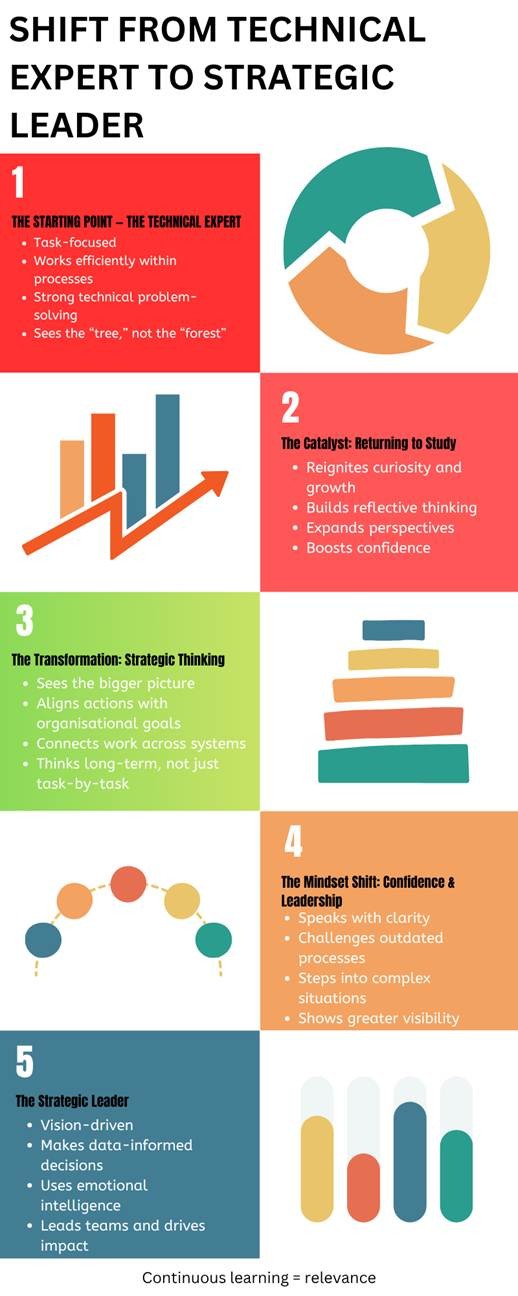
This transformation extends to how professionals approach challenges. They no longer shy away from difficult conversations or complex projects. Instead, they step into these situations with confidence and a mindset shaped by strategic thinking and emotional intelligence nurtured through reflective learning. It is not just about having knowledge. It is about having the confidence to apply it effectively.
The ripple effect – organisational impact
The true power of education lies in its practical application in the workplace. As you advance in your studies, you begin to notice tangible shifts in behaviour. You question outdated processes and offer data-driven solutions aligned with organisational strategies.
You volunteer for leadership opportunities because your education has equipped you with more than technical expertise. It has given you the confidence to lead. This speaks to the transformative power of aligning actions with purpose. Going back to study empowers professionals to become deliberate leaders who can navigate complex situations with clarity and strategic intent.
As Boud, Keogh and Walker note, “the characteristics and aspirations of the learner are the most important factors in the learning process”. These factors shape how confidently individuals approach new experiences and how fully they engage with them. When studying alongside diverse peers, each person’s history influences how they perceive challenges, opportunities and change. This diversity stretches critical thinking, sharpens curiosity and opens new ways of understanding workplace issues.
Strategic value for organisations and individuals
For organisations, the impact of employees returning to study and going back to study is significant. These employees return with a broader vision. They see how their work contributes to immediate tasks and how it fits into the larger strategic framework. This shift elevates the organisation because employees approach challenges with thoughtful and innovative mindsets.
The results of returning to study are not just personal; they are professional. Armed with strategic insights gained from education, you can increase your visibility within your organisation. Studying opens pathways to leadership, not just because of technical knowledge, but because of confidence and strategic thinking. This is the true value of education. It is not just a means of career advancement. It is a catalyst for personal empowerment.
Education provides tools for building career momentum. As you acquire new knowledge, you become more involved in key decisions. You offer solutions that contribute to organisational growth and gain confidence to take on leadership roles. Education allows professionals to position themselves as strategic thinkers who can lead teams and drive business results, not just technical experts.
Education as a continuous identity transformation
What is particularly powerful is how education reinforces growth over time. Each course, reflection and application of knowledge compounds, creating momentum that propels your career forward. This momentum is not just about acquiring credentials. It is about reshaping identity within the organisation as a leader and strategic thinker.
In a world where professional landscapes constantly shift, the power of education is undeniable. Going back to study is not just about acquiring knowledge. It is about transforming how you think, lead and engage with others. It is a journey that equips you with skills, clarity and strategic insight to shape your future as a leader. This is the true value of education. It changes how you show up, not just in your career, but in every aspect of your life.