




Casey Sprake | Economist | Anchor Capital | mail me |
South Africa’s Medium-Term Budget Policy Statement (MTBPS) is a key mid-year fiscal update that reviews performance against the February Budget. It also reallocates spending where needed and recalibrates priorities for the year ahead.
SA’s 2025 MTBPS came against a more constructive backdrop than earlier in the year. Broader consultation within the Government of National Unity (GNU) and improved in-year fiscal performance helped set a more measured and market-friendly tone.
The market responded quickly and positively. The rand strengthened. Bond yields eased. Bullish sentiment grew around “SA Inc”.
Two announcements stood out:
- The National Treasury (NT) reduced weekly fixed-rate government bond issuance from R3.75 billion to R3 billion. This larger-than-expected cut signalled confidence in funding conditions and a smaller borrowing requirement.
- The finance minister endorsed a 3% inflation target with a 1% tolerance band. This decision aligned fiscal and monetary policy. The South African Reserve Bank (SARB) had informally targeted this level, but Treasury’s formal adoption strengthened credibility and reinforced the SARB’s independence.
Together, these announcements reflected a shift in tone. SA’s 2025 MTBPS demonstrated a commitment to coordination, prudence and discipline. These are key ingredients for investor confidence. One notable outcome is that gross loan debt is still projected to peak this year, although at a higher rate.
Debt and deficit outlook
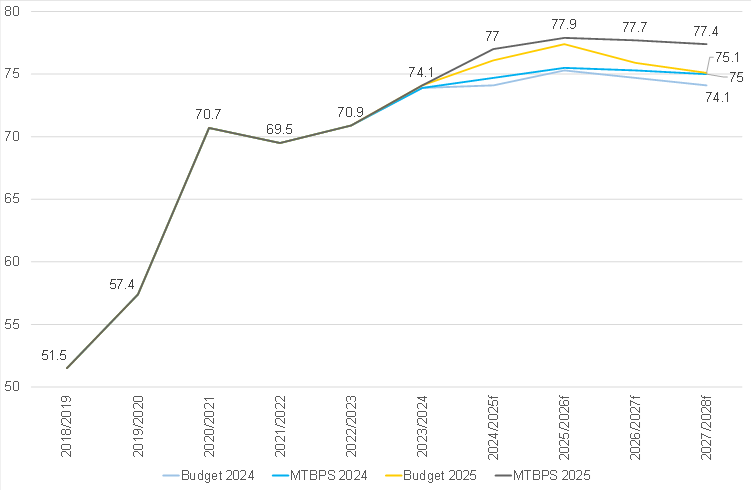
Treasury expects debt to stabilise at 77.9% of GDP in FY25/FY26. This is marginally better than market expectations. Debt-service costs are moderating because of lower inflation, a stronger Rand and improved funding conditions. The consolidated budget deficit is projected to narrow from 4.7% of GDP in FY25/FY26 to 2.9% by FY27/FY28.
Figure 1 – SA government debt forecasts as a percentage of GDP, %
Source: NT, Anchor
Growth-focused spending priorities
Revenue performance exceeded expectations by R19.7 billion for the current fiscal year. Stronger VAT, corporate tax and fuel levy collections drove this increase. The improvement reflects resilient household spending, commodity-linked corporate performance and better efficiency at the South African Revenue Service (SARS). However, the medium-term revenue outlook is more subdued.
Lower inflation and weaker nominal GDP growth narrow the tax base. On the expenditure side, total spending was revised R36 billion lower over the medium term relative to the May 2025 Budget. This largely reflects savings from a softer inflation trajectory and underspending in certain departments.
Encouragingly, Treasury is using this fiscal space to reorient spending toward growth-enhancing investment. Infrastructure outlays remain a priority. Payments for capital assets will grow by 7.3% over the medium term. This is the fastest growth among all spending categories. Additional allocations support Transnet infrastructure rehabilitation, disaster recovery, and capital injections into the new credit guarantee vehicle (CGV).
The CGV was created to de-risk infrastructure projects and mobilise private capital for SA’s energy and climate goals. It is expected to be operational in June 2026 and will issue guarantees for projects. While Treasury will inject the initial funding, the CGV will operate as a majority privately owned, regulated non-life insurance company.
At the same time, Treasury is advancing its new multi-year budgeting and procurement reforms. The Targeted and Responsible Savings (TARS) initiative, performance-based frameworks, and a new Procurement Payments Dashboard aim to eliminate duplication, enhance transparency and improve efficiency in public spending. The government has also begun auditing payroll data to detect “ghost workers”. This strengthens accountability at the provincial and national levels.
Risks and fiscal challenges
These reforms indicate a shift toward building credibility through implementation rather than promises. For many years, weak oversight and poor coordination undermined South Africa’s ability to deliver value for money. If these new frameworks gain traction, they could create fiscal space to protect core services while increasing productive investment. The key will be maintaining momentum and avoiding political interference that could erode progress.
Still, the fiscal outlook carries risks. Weaker global growth, commodity-price volatility and the precarious financial health of several state-owned entities (SOEs) remain significant vulnerabilities.
High debt redemptions will sustain large borrowing requirements. The slow pace of structural reform, particularly in energy, logistics and local government, continues to constrain growth. Political uncertainty within the GNU also introduces potential execution risk.
In conclusion
Nevertheless, despite these challenges, the overall message from SA’s 2025 MTBPS is one of cautious stability. Reduced bond issuance, alignment of inflation objectives and stronger spending discipline have been well received by markets. These steps signal a deeper commitment to consolidation.
In the short term, they should ease funding pressures, lower borrowing costs, and support a firmer rand. This may create room for the SARB to consider monetary easing later in 2026. Over time, consistent delivery and credible reform could lower South Africa’s risk premium, attract investment and support a more durable growth trajectory.