





If you’re curious about the natural habitats of the ancient Ayurvedic herb ashwagandha, you’ve come to the right place. Ashwagandha (Withania somnifera), also known as Indian ginseng or winter cherry, is an evergreen shrub. So where does ashwagandha grow? It primarily thrives in tropical and subtropical regions of Asia, Africa, and Europe.
Originating from the Indian subcontinent, ashwagandha has been used extensively in traditional Ayurvedic and Unani medicine systems for centuries. The plant is rich in phytochemicals, including steroidal lactones called withanolides. These compounds are believed to be responsible for many of its proposed health benefits.
Key takeaways
- Ashwagandha is an evergreen shrub native to the Indian subcontinent.
- It thrives in tropical and subtropical regions of Asia, Africa, and Europe.
- The plant is rich in phytochemicals like withanolides, which contribute to its medicinal properties.
- Ashwagandha has been used extensively in traditional Ayurvedic and Unani medicine systems.
- Its natural habitats and cultivation areas are found in diverse geographic regions.
- USER WARNING – Avoid untested products. Opt for reputable brands with verified quality and positive social proof to ensure safety and efficacy.
- NEED TO PURCHASE? – OUR PREFERRED PRODUCT PICKS:
- Best overall supplement – Physician’s Choice with over 27,000 user reviews
- Best root powder extract – KSM-66 Ashwagandha with over 6,800 reviews
- Best value – Nutricost Ashwagandha Capsules with over 1,900 reviews
Disclaimer
The information provided on this blog is for informational purposes only and is not intended as a substitute for professional medical advice. While we strive to share knowledge and insights on wellness topics, readers should not interpret any content found here as medical advice. We encourage all readers to consult with qualified healthcare practitioners for personalized medical guidance and to address any health concerns they may have.
Introduction to Ashwagandha
Ashwagandha, scientifically known as Withania somnifera, is a plant with deep roots in traditional Indian medicine. It belongs to the Solanaceae family and can reach up to 2 meters tall. This gives us a glimpse into its botanical classification and origins.
Origins and Botanical Classification
The name “Withania somnifera” comes from the Latin words “somnus” meaning sleep and “ferre” meaning to bring. This reflects the plant’s believed sleep-inducing properties. Ashwagandha is classified in the Withania genus, part of the Solanaceae family, which also includes tomatoes, potatoes, and chili peppers.
For centuries, Ashwagandha has been a key part of Ayurvedic medicine. It’s valued for its adaptogenic properties, helping the body manage stress. Its wide range of uses has made it a fundamental part of traditional healing, earning it the names “the winter cherry” or “Indian ginseng.”
“Ashwagandha is an ancient medicinal herb that has been used in Ayurvedic medicine for centuries.”
Geographical Distribution and Growing Regions
Ashwagandha, a versatile medicinal plant, thrives mainly in the Indian subcontinent. Major cultivation areas include Uttar Pradesh, Punjab, Gujarat, Haryana, Rajasthan, Madhya Pradesh, and Maharashtra. It has also made its way to the Mediterranean region, growing in Spain, North Africa, and the Middle East. This is due to its ability to adapt to diverse soil and climate conditions.
The Indian Subcontinent
The Indian subcontinent stands out as the primary center for ashwagandha cultivation. Its dry, stony landscapes and abundant sunlight create perfect conditions for the plant. For centuries, farmers here have cultivated ashwagandha, utilizing its medicinal properties within traditional Ayurvedic practices.
The Mediterranean Region
Though less prominent than the Indian subcontinent, the Mediterranean region is another key area for ashwagandha cultivation. Here, it’s often grown in private gardens, benefiting from the region’s favorable climate and soil. Ashwagandha’s adaptability enables it to flourish in the Mediterranean’s varied growing regions and cultivation areas, expanding its global reach.
In both the Indian subcontinent and the Mediterranean region, ashwagandha’s distribution highlights its resilience and versatility. Its ability to grow in different environments has made it a global phenomenon. Its benefits are now recognized and celebrated worldwide, across various cultures.
Where does ashwagandha grow

Ashwagandha (Withania somnifera), a remarkable adaptogenic herb, thrives in the Indian subcontinent and the Mediterranean. It grows in open, dry, and sunny areas, adapting to various soil types. These include sandy, stony, and disturbed soils.
In India, Pakistan, Sri Lanka, Afghanistan, and Iran, ashwagandha is widely cultivated. Its geographic range extends beyond these countries. It is also grown in parts of North Africa, the Middle East, Europe, and China.
Ashwagandha’s ability to grow in diverse climates has made it a global phenomenon. It is cultivated and used worldwide, from the Indian subcontinent to the Mediterranean. This plant fascinates botanists, herbalists, and health enthusiasts.
The global cultivation of ashwagandha shows its adaptability and growing health benefits. As research reveals its potent properties, demand for this herb is expected to rise. This will lead to its expansion into new regions worldwide.
Ideal Growing Conditions
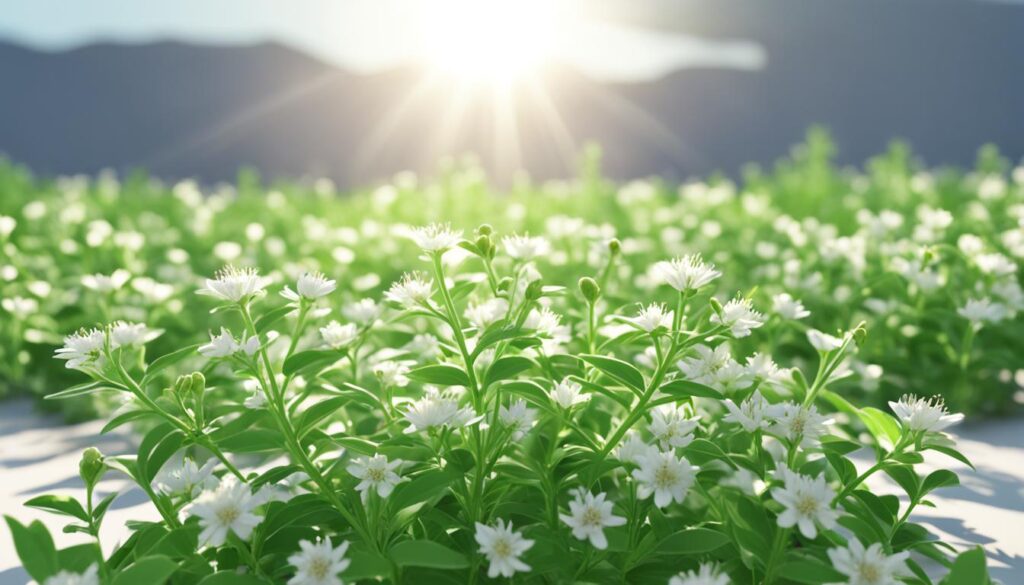
If you’re keen on growing the versatile and medicinal ashwagandha plant, grasping the ideal growing conditions is crucial. This plant, renowned for its resilience, excels in environments with precise climate and soil requirements.
Climate Needs for Ashwagandha
Ashwagandha (Withania somnifera) excels in tropical and subtropical regions with warm, dry climates. It demands full sun exposure and adapts to a broad spectrum of soil types, including sandy, stony, and well-drained soils. Thriving in areas with an annual rainfall of 500-1,000 mm and an average temperature range of 20-30°C, it also flourishes in regions with lower rainfall, provided the soil is well-drained. This versatility makes it a versatile crop for cultivation in various regions.
Optimal Soil Conditions
Apart from climate requirements, ashwagandha has distinct soil preferences. It prospers in well-drained, nutrient-rich soils that are neither too acidic nor too alkaline. Sandy, stony, or loamy soils are particularly conducive for ashwagandha, offering the necessary drainage and aeration for its root system to flourish.
| Ashwagandha Cultivation Conditions | Optimal Range |
|---|---|
| Climate | Tropical to subtropical, warm and dry |
| Sunlight | Full sun exposure |
| Rainfall | 500-1,000 mm annually |
| Temperature | 20-30°C average |
| Soil Type | Well-drained, sandy, stony, or loamy |
| Soil pH | Neutral to slightly alkaline |
Grasping the ideal climate and soil requirements for ashwagandha cultivation ensures optimal growing conditions for this remarkable medicinal plant.
“Ashwagandha is a remarkably adaptable plant, thriving in diverse climates and soil conditions, making it an excellent choice for cultivation in many regions.”
Conclusion
Ashwagandha, scientifically known as Withania somnifera, is a remarkable medicinal plant. It flourishes in the Indian subcontinent and the Mediterranean, adapting to diverse climates and soils. This adaptability has made it a key herb in traditional medicine, especially in India.
In the Indian subcontinent’s tropical and subtropical zones, and the Mediterranean’s temperate climates, ashwagandha finds its ideal home. It thrives under full sun and in soils that drain well, whether sandy or stony. These conditions support its cultivation, ensuring its availability for research and health benefits.
Understanding ashwagandha’s geographical range and ideal conditions highlights its importance in traditional and modern medicine. As interest in natural remedies grows, so does the need to cultivate and protect its habitats. Researchers, farmers, and health advocates all focus on this, ensuring ashwagandha’s continued availability and study.
FAQ
Where is ashwagandha primarily cultivated?
Ashwagandha (Withania somnifera) is mainly grown in Asia’s tropical and subtropical areas. It’s especially common in the Indian subcontinent. Key cultivation areas include Uttar Pradesh, Punjab, Gujarat, Haryana, Rajasthan, Madhya Pradesh, and Maharashtra in India.
Does ashwagandha grow in other parts of the world?
Yes, ashwagandha also thrives in parts of the Mediterranean, like Spain, North Africa, and the Middle East. It has been introduced and cultivated globally, adapting to diverse soils and climates in Europe, Africa, and China.
What is the natural habitat of the ashwagandha plant?
Ashwagandha (Withania somnifera) excels in dry, sunny environments. It’s adaptable, growing on various soils, including sandy, stony, and disturbed ones.
What are the ideal climatic conditions for growing ashwagandha?
Ashwagandha (Withania somnifera) thrives in warm, dry climates typical of tropical and subtropical regions. It needs full sun and can grow on a variety of soils. Preferring an annual rainfall of 500-1,000 mm and temperatures between 20-30°C, it’s well-suited for specific climates.
Can ashwagandha be cultivated in other regions besides the Indian subcontinent and Mediterranean?
Indeed, ashwagandha’s versatility allows it to be cultivated worldwide. While it’s mainly grown in the Indian subcontinent and the Mediterranean, it has been successfully introduced and cultivated in Europe, Africa, and China.
Source Links
- https://ods.od.nih.gov/factsheets/Ashwagandha-HealthProfessional/
- https://www.sciencedirect.com/topics/pharmacology-toxicology-and-pharmaceutical-science/withania-somnifera
- https://www.ahpa.org/herbs_in_history_ashwagandha