





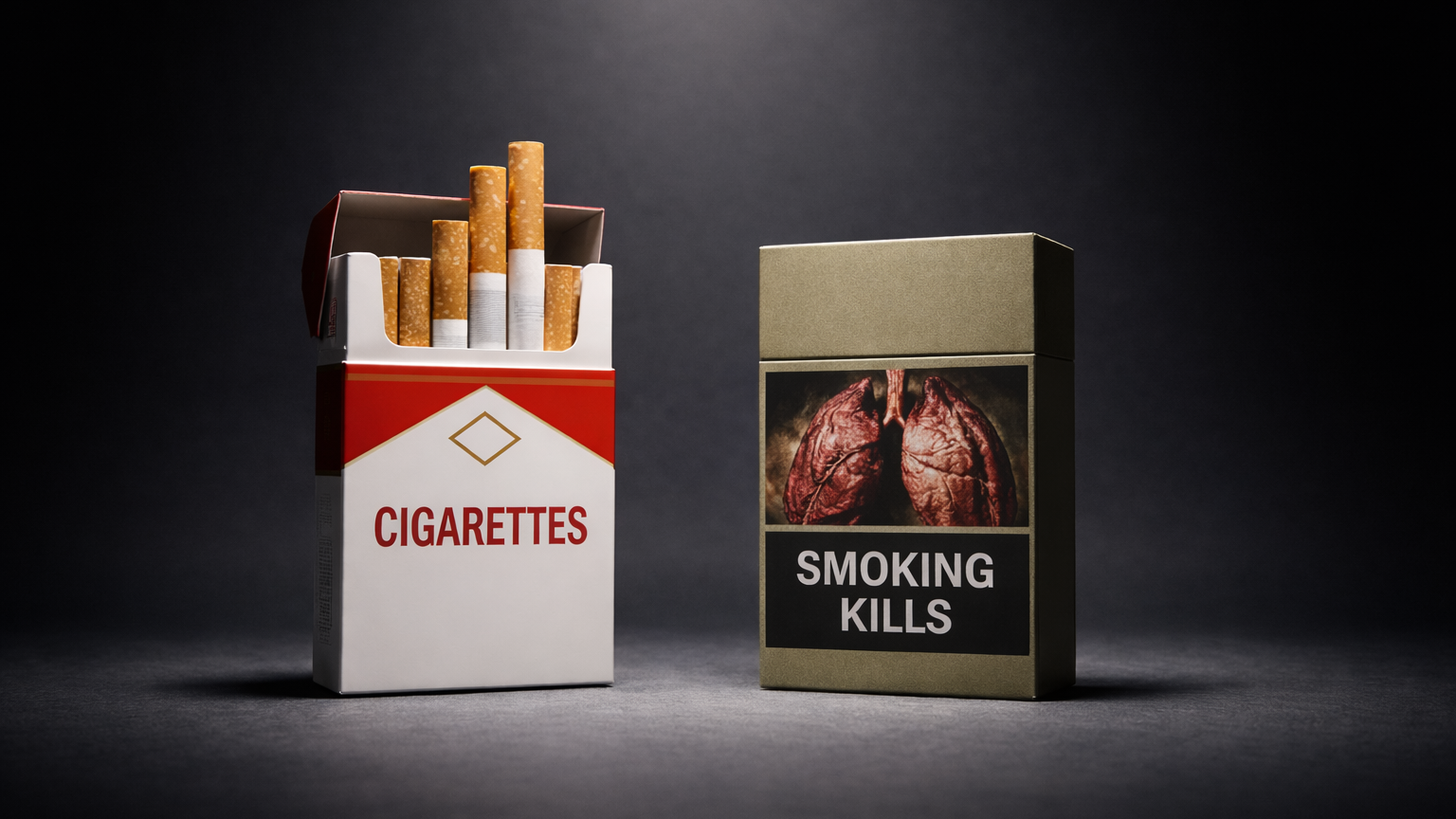
Over the last several decades, governments worldwide have pushed strongly to regulate tobacco and tobacco products. Their goal is to reduce tobacco consumption. These efforts increasingly focus on stricter rules for cigarette packaging and related marketing practices.
Beyond standardised packaging, governments now introduce complementary policies. These include flavour bans, restrictions on retail displays, nicotine limits, environmental regulations and traceability systems to combat illicit trade. Together, these measures target hidden marketing tactics embedded in cigarette packaging and product presentation.
These initiatives aim to curb the tobacco industry’s ability to market products through visual cues or sensory appeal. In particular, regulators want to reduce the attractiveness of cigarette packaging for young people and first-time smokers.
The global trends
According to the Canadian Cancer Society (CCS), 42 countries and territories had introduced measures toward plain packaging by February 2024. Of these, 25 adopted the measure. Three have already implemented it in practice, while 14 are continuing implementation processes.
The CCS report, titled Cigarette Package Health Warnings: International Status Report, outlines global progress on plain packaging and cigarette packaging regulations. The report ranks 211 countries and territories according to the size of their health warnings on cigarette packages. It also lists 138 countries and territories that now require graphic picture warnings.
A growing number of countries continue to adopt plain packaging laws for tobacco products. This development reflects a strong international movement to reduce smoking rates and protect public health. Policymakers particularly focus on protecting youth from the marketing influence of cigarette packaging.
Australia led this movement in 2012. Since then, countries such as France and the United Kingdom have followed with similar measures.
Expansion of plain packaging laws
Currently, 25 countries and territories have implemented plain packaging regulations. This number represents a sharp increase from just 9 in 2018 and 21 in 2021. Consequently, the steady rise highlights the global commitment to reducing tobacco consumption through tighter cigarette packaging controls.
Plain packaging policies aim to reduce the attractiveness of tobacco products. They also limit misleading design cues and strengthen the impact of health warnings.
The World Health Organisation supports these policies through the WHO Framework Convention on Tobacco Control (WHO FCTC). The convention encourages countries to remove promotional elements from tobacco and cigarette packaging.
Typically, these regulations require several key measures.
These include:
- Standardised packaging formats.
- Removal of logos, colours and design features.
- Uniform font style and size for brand names.
- Prominent health warnings.
- Use of unattractive colours, such as dull brown, to deter appeal
Health warnings and graphic images now dominate pack design in several jurisdictions.
Eliminating packaging as a marketing tool
Regulators want to eliminate packaging as a marketing tool. They also want to enhance the visibility of health warnings and reduce misleading messaging about tobacco risks. As a result, cigarette packaging increasingly functions as a public-health instrument rather than a branding platform.
Countries that already implemented these measures include Australia, France, the United Kingdom, Norway, Ireland, New Zealand, Saudi Arabia, Turkey, Thailand, Canada, Uruguay, Slovenia, Belgium, Israel, Singapore, the Netherlands, Denmark, Guernsey, Hungary, Jersey and Finland.
Meanwhile, implementation continues or remains pending in Mauritius, Myanmar, Oman and Georgia. Notably, Myanmar also introduced a generational tobacco ban. This rule prohibits public tobacco consumption for individuals born after 2007. The policy aims to create the country’s first tobacco-free generation.
Adoption through import policies
Additionally, three territories effectively adopted plain packaging through import arrangements. These territories include Monaco, the Cook Islands and Niue.
They achieve this outcome by importing tobacco products from countries where plain packaging regulations already apply. Consequently, cigarette packaging entering these territories already complies with strict packaging rules.
At least 14 more countries currently consider similar legislation. These include South Africa, Mexico, Malaysia, Colombia and Russia. Therefore, the trend toward stricter cigarette packaging regulation will likely continue.
Deprivation of intellectual property rights?
The introduction of plain packaging laws triggered litigation in several jurisdictions. This occurred after implementation in Australia and the United Kingdom. The legal question concerned constitutionality. Specifically, critics argued that plain cigarette packaging deprived companies of intellectual property rights linked to branding elements such as logos.
In 2012, the High Court of Australia upheld the country’s plain packaging laws. Later, in 2015, the Court of Appeal of England and Wales reached a similar conclusion.
In 2020, opponents challenged the legislation before the World Trade Organisation (WTO). The complaint targeted Australia’s plain packaging regime and the restrictions placed on cigarette packaging branding. The WTO Appellate Body ultimately upheld the earlier rulings. It confirmed that plain packaging legislation serves a legitimate governmental objective. It also recognised that Australia’s law contributes meaningfully to achieving that objective.
So far, public health concerns and risk-reduction incentives have outweighed the branding rights of tobacco companies.
Evidence and ongoing debate
Plain packaging legislation has existed in some jurisdictions for more than a decade. Consequently, a growing body of research examines its impact on tobacco consumption.
Interpretations of this evidence vary widely. Some studies show reductions in tobacco consumption, particularly among children. Other analyses claim the policy increased consumption and stimulated illicit trade.
South Africa occupies a unique position within this debate. The country experienced a surge in illicit tobacco trade during the early months of the COVID-19 pandemic. At that time, authorities banned tobacco sales.
The progress of South Africa’s bill
South Africa’s Control of Tobacco Products and Electronic Delivery Systems Bill, 2022, currently moves through Parliament. The public participation and comment period has already concluded.
The parliamentary Committee on Health now reviews the submissions received during this process. Notably, both the South African Police Service (SAPS) and the South African Revenue Service (SARS) addressed the Committee. Their input aims to highlight broader economic and enforcement implications associated with the illicit tobacco trade.
SARS has raised concerns about plain cigarette packaging regulations. The agency warned that such measures may unintentionally expand illicit trade. To mitigate this risk, SARS proposed an alternative approach. It suggested that policymakers should require large, visible health warnings on cigarette packaging. This option would still support public health goals while allowing easier identification of legally regulated products.
In conclusion
In countries where plain packaging laws apply, cigarette packaging no longer functions primarily as a marketing tool. Instead, regulators now treat it as a public-health instrument. However, some jurisdictions still permit limited brand identity on cigarette packaging. Typically, the brand name appears in all caps using size-12 Arial font.
This regulatory space remains dynamic and important. Tobacco consumption continues to pose serious public-health risks. At the same time, illicit trade presents complex economic challenges.
In countries such as South Africa, the illicit tobacco trade continues to grow. Consequently, policymakers must balance competing interests. These include public health priorities, enforcement realities and economic consequences.
From the minutes of a recent parliamentary meeting, the committee acknowledged the value of SAPS and SARS perspectives. These enforcement institutions contribute practical insights to the legislative process. Although some stakeholders argue that illicit trade lies outside the scope of plain packaging legislation, the committee recognised another responsibility. It must continue parliamentary oversight of this issue.
 |
 |
 |
| Sajidha Gamieldien | Partner | mail me | | Nicole Haworth | Senior Associate | mail me | | Aimee Du Plessis | Candidate Attorney | mail me | |
| | Adams & Adams | | ||