


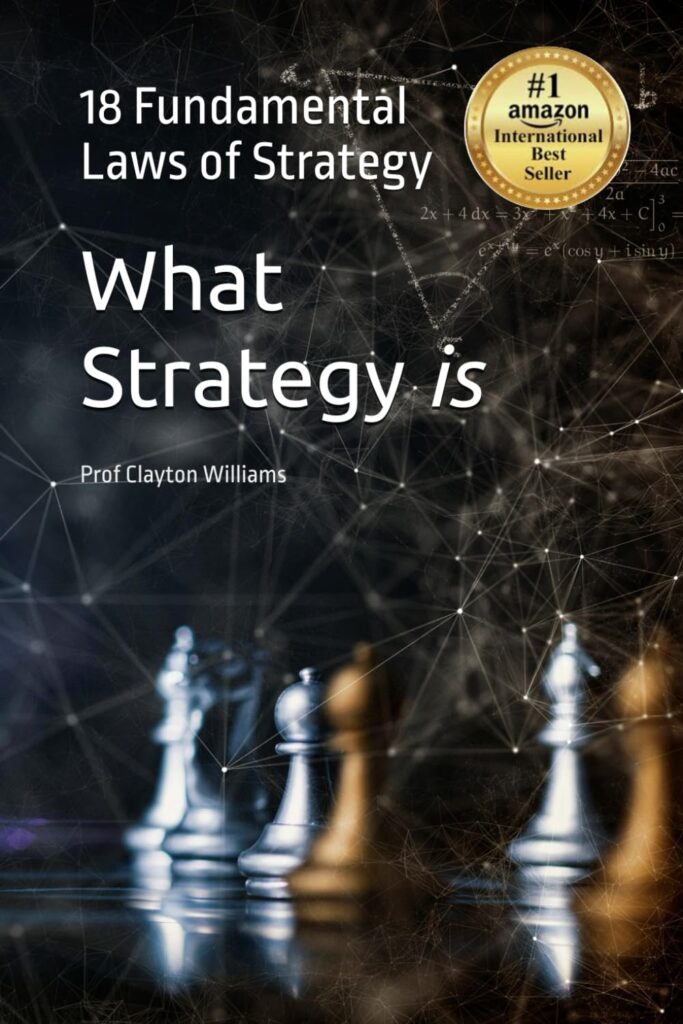
The 18 Fundamental Laws of Strategy
By Professor Clayton Fraser Williams
Traditional strategy rests on assumptions that often fail when organisations face uncertainty, complexity and rapid change. Professor Clayton Fraser Williams challenges these assumptions. He asks a deceptively simple question: What is strategy?
Williams offers a rigorous and practical answer. He draws on quantum mechanics, complexity science, thermodynamics, information theory, decision science and systems thinking. As a result, the book moves beyond familiar slogans, frameworks and managerial heuristics. It presents strategy as a coherent discipline that can explain behaviour across different systems.
A scientific reframing of strategy
Central to the book are the 18 Fundamental Laws of Strategy. These laws examine how strategy operates across companies, governments, technologies, markets, biological systems and artificial intelligence. They also provide leaders with tools for navigating variability, market dynamics, uncertainty and complex organisational design.
Importantly, the book extends the discussion beyond conventional management thinking. Williams presents strategy as a natural phenomenon rather than an activity that humans simply invented. Organisms, organisations and institutions must all obtain information, consider possible futures, allocate scarce resources and act without complete certainty.
For readers who want to rethink established strategic practice, the book provides an ambitious scientific perspective.
The book will appeal particularly to:
- C-suite leaders
- Strategy professionals and executives
- Policymakers and entrepreneurs
- Systems thinkers and researchers
About the author
Professor Clayton Fraser Williams writes about strategy as a universal process through which organisms, organisations and institutions pursue advantage under uncertainty, entropy and finite resources. His broader project, Principia Strategica, extends this thinking across biological, organisational, institutional and political systems.
Williams argues that strategy existed long before humans developed the vocabulary to describe it. By connecting strategy with complexity, probability, thermodynamics, information and evolutionary reasoning, he invites readers to examine strategic practice through a fundamentally different lens.
- PUBLISHER | Independently Published |
- ISBN | 979-8280197497 |
- Recommended Retail Price | R495.00 |
- Classification | Management & Leadership |