


Professor Adré Schreuder | Founder and Chairperson | The South African Customer Satisfaction Index (SA-csi) | mail me |
It’s these experiences that feed into the latest SA-csi for Life Insurance (2018) we conducted. The index provides highly scientific insights into the overall level of satisfaction of customers of South Africa’s major life insurers – 1Life Insurance, Absa Life, Discovery Life, FNB Life, Liberty, Metropolitan, Momentum, Old Mutual and Sanlam.
In the 2018 SA-csi for Life Insurance, FNB Life clinched the top spot with SA’s most satisfied customers. Metropolitan still registered above industry average, whilst Old Mutual, Sanlam, Absa Life, 1Life Insurance and Discovery Life all following on par, while Liberty and Momentum are below industry par.
All insurers showed some decline on the previous year’s index scores with the exception of Discovery and Sanlam.
Managing customer perceptions
Customers have high expectations given that life insurance is a product they or their families will possible need at some point in future where an unforeseen crises arise either as a result of death, disability or illness.
Touch points with customers are also low in frequency and depth of real engagement until claims time, when a customer gets to experience whether the insurer delivers on promises and expectations. It’s also the most emotionally fraught time.
One of the big take-outs from the research is that as a whole, the industry needs to address the common misperception that insurers will look for reasons not to pay claims.
It’s a perception that is simply not backed by the facts if you consider that the Association for Savings and Investment South Africa (Asisa) released the statistics for long-term insurance claims made during 2018, showing that life insurers paid out R15.1 billion in death benefits to beneficiaries and policy-holders during the year – equivalent to 99.3% of the value of all claims made.
The percentage of claims that were repudiated or escalated to the ombud amounts to just 0.7%. It was very revealing to note the impact that recent news reports on claims rejections like that of the Nathan Ganas case, Liberty’s cyber hack in 2018, and various other claims rejections reported in the life ombud annual report have had on the public image of life insurers.
During the field research, our respondents mentioned ‘trust’ and ‘delivering on promises’ as their key satisfaction criteria – significantly ahead of cost.
A new model beyond compliance only?
Trust and doing business with integrity should be hygiene factors and not differentiators, and yet these issues were front and centre for life insurance customers. It points to the need for a new model of insurance underwriting and claims assessment that moves beyond mere compliance and legal protocols when it comes to customer complaints and experience.
It’s evident from the feedback that the time for insurers to do some introspection is overdue when you consider that customer perceptions and reality are at polar extremes.
The question that must be addressed is whether claims rejections and complaints handling are done on grounds that are fair and reasonable to the customer, versus purely on a legalistic basis, and whether such situations could have been avoided altogether with proper measures in place to educate and inform customers.
It is understandable that customers question why anomalies can be picked up at claims time, and not at inception of the cover.
In an industry that is run on numbers and statistics, it is easy to overlook the fact that at the end of it all, a human being is involved whose life and livelihood is affected by the decisions made. Context matters for South African consumers and following the letter of the law is simply not enough.
Tough decisions can no longer be made based on numbers only, without giving deep consideration to the human element, goodwill and doing the right and fair thing.
Bancassurance makes inroads into traditional insurance markets
An interesting aspect of the SA-csi for Life Insurance 2018 is that the top performing brand for the last two years – FNB Life – is a bancassurance provider and not a traditional life insurer.
Bancassurance – the process of selling insurance products through banking channels – has been growing rapidly despite being a relatively new player in the South African insurance space.
The ability of banks to integrate life insurance into trusted and digitised banking systems as part of a more holistic financial services offering represents a competitive threat to traditional insurers.
Added to this, bancassurance products are typically simpler to understand, easy to access and sign up, and in many instances require no costly underwriting.
FNB Life has been reported as one of the fastest growing life insurance brands – it has access to data, analytics and deep customer insights and immediate access to millions of its banking customers – it’s not difficult to see why it is emerging as a real market challenger in the life space.
Delivering powerful customer experiences and omni-channel customer satisfaction will be critical to life insurers remaining relevant in an environment where traditional distribution channels have been slow to adapt to the changing demands and expectations of consumers.
Key take-outs
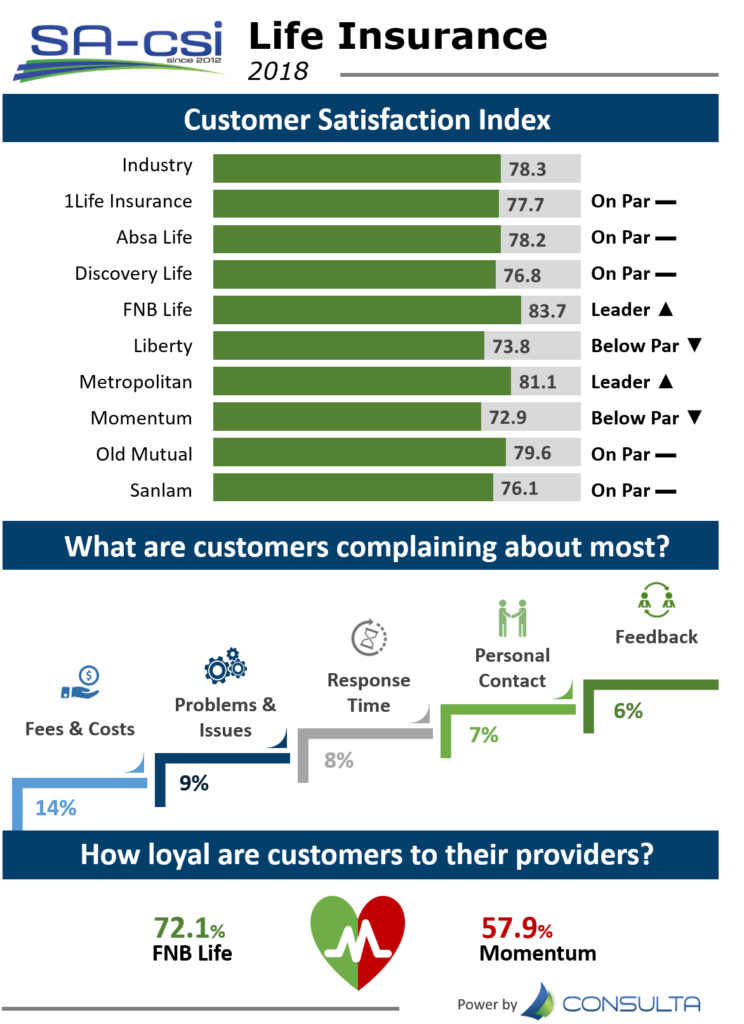

Customer satisfaction – overall index
- FNB Life leads the pack at 83.7 and well above the industry par of 78.3. Metropolitan follows also in a above industry average position with 81.1. Both FNB Life and Metropolitan increased their overall satisfaction index scores compared with 2017 – a notable achievement considering they were operating off a high base which is typically challenging to improve upon.
- Old Mutual (79.6), Sanlam (79.2), Absa Life (78.2), 1Life Insurance (77.7) and Discovery Life (76.8) all follow on par.
- Liberty (73.8) and Momentum (72.9) follow below par and with a significant gap between their closest competitors. Both insurers have faced a three-year downward trend in customer satisfaction scores.
Customer expectations and perceived quality
- All brands met or exceeded customer expectations with the exception of Momentum and Liberty – both these brands fell short of meeting expectations, with the biggest gaps particularly around the reliability of the offering.
Perceived value
- Perceived value is a measure of the quality, relative to the price paid. FNB Life leads on perceived value by a significant margin against all competitors with 87,1 compared with the industry par of 79.2 and has improved with 3,3 index points compared with 2017.
- Metropolitan (81.6) and Old Mutual (80.6) follow also in above industry average positions.
- 1Life (80.2), Absa Life (79.9) and Sanlam (79.5) are on par. Discovery Life (76.4), Liberty (75.6) and Momentum (74) all score well below the rest of the industry. Discovery has the biggest gap between price-quality alignment with a margin of -6.1, meaning that customers don’t believe the quality of the cover and benefits warrant the price paid.
Complaints incidence and resolution
- Of the complaint incidence across all brands, customers complained most often about Fees and cost 14%, problems and issues 9%, response time 8% and personal contact 7%. It is notable that customers who highlighted feedback and personal contact as their key complaints also have the lowest overall satisfaction scores – indicating that these are significant points of contention for customers.
- In terms of complaints incidence and handling, FNB has a complaint incidence score of 7.9% which is lower than the industry average of 8.2% and an extraordinary complaint handling score of 75.6 which is leaps ahead of industry par (45.7). By global standards, a score above 50/100 is considered world-class.
- Metropolitan follows with a 6.8% complaint incidence and the second highest complaint handling score index of 56.7.
- It is clear that FNB Life and Metropolitan have prioritised this aspect of their business models, which is testimony of their leadership in having South Africa’s most satisfied customers.
- Sanlam has the lowest complaint handling score of 33.8 which signifies a marked decline in its previous year’s score of 57.3. Absa Life follows at 39.2 and Momentum at 41.4 – both below par (45.7).
Customer loyalty
- FNB Life has the highest percentage of loyal customers at 72.1% and above the industry par of 64.8%. FNB Life has increased its customer loyalty score of 71 in 2017 and is the only brand to have done so. All other brands have shown a decline in customer loyalty.
- Momentum has the lowest score of 57.9% followed by Liberty at 58.6%. Momentum’s customer loyalty score has been declining for five consecutive years, dropping 16.4% from 74.3% in 2014. Liberty has seen a 16.5% decline from 75.1% in 2014.
- Customer loyalty across the sector has declined from a high of 73.6% in 2014 to 64.8% in 2018.
Net promoter score
- Net Promoter Score measures the likelihood of a person recommending a brand. FNB Life has the highest Net Promoter Score (NPS) at 59%, which is much higher than the industry average (33%). This is followed by Old Mutual at 40.1% and Sanlam at 36%, both above par.
- Metropolitan (34.9%) and Absa Life (32.9%) come in on par.
- Discovery Life (29.4%), 1Life Insurance (26.1%) come in below par.
- Liberty at 16.3% has seen a dramatic drop from its highest score of 30.4% in 2016, while Momentum has registered a low of 10.5% in 2018, radically down from its highest score of 32.8% in 2015.
Treating Customers Fairly (TCF)
- The degree to which customers feel they are being treated fairly by their insurer is highest with FNB Life (87.6) well above industry par of 80.2, followed by Absa Life (81.5), Old Mutual (81.5), Sanlam (81), 1Life Insurance (81) and Metropolitan (80.8) – all above par.
- Discovery Life (78.6) and Liberty (77.5) come in below par, while Momentum comes in significantly below par (74.4) with the lowest score.
In conclusion
The SA-csi for Life Insurance is the most comprehensive survey of customer satisfaction, and is a causal model that links customer expectations, perceived quality, and perceived value to customer satisfaction (the SA-csi score), which in turn is linked to customer complaints (and recovery), and customer loyalty intentions.
As a strategic tool for gauging the competitiveness of individual firms and predicting future profitability, an organisation’s customer satisfaction performance, as measured by the SA-csi methodology, provides a predictive indication of how well the firm will perform in terms of future revenue and earnings growth.
Supported by both the scientific and practitioner community, the SA-csi is the first independent, comprehensive national customer satisfaction index with international comparability in South Africa and has collected data from more than 400,000 consumers since its inception in 2012.
The SA-csi forms part of a global network of research groups, quality associations and universities that have adopted the methodology of the American Customer Satisfaction Index (ACSI) via its Global CSISM program.