



Marc Beckenstrater | Fund Manager | PSG Asset Management | mail me |
South African bond markets rewarded fixed-income investors with exceptional calendar-year returns in both 2024 and 2025. The All Bond Index (ALBI) returned 17% and 24%, respectively. These returns significantly exceed the norm. Therefore, we anticipated moderating performance in 2026.
This expectation was especially relevant because the market had repriced strongly. Risk perceptions around the local economy and political climate improved, the risk premium declined, and foreign investors once again found local bonds attractive.
FTSE/JSE All Bond
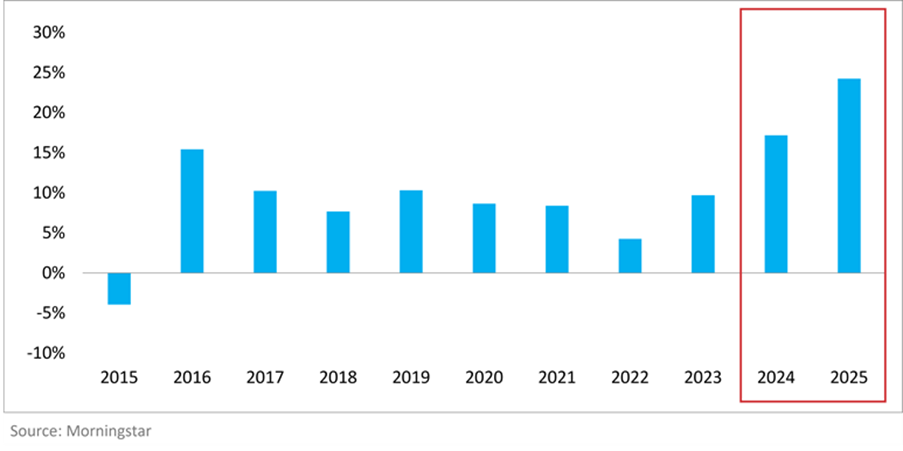

We entered 2026 with local nominal government bond returns looking respectable. However, they appeared less attractive than during the previous two years.
It’s been a tough year for bonds so far
Global developments in 2026 have not supported bonds. For example, the conflict in Iran sent oil prices sharply higher and triggered inflation spikes.
Compounding the inflation picture, the United States (US) faces a structural fiscal challenge that markets can no longer ignore. The federal deficit remains at levels historically associated with wartime or crisis. At the same time, the Treasury must roll over and issue new debt at scale. As a result, bond investors, often called bond vigilantes, have reasserted themselves as an effective constraint on fiscal and monetary excess.
In the absence of a credible consolidation path, the market is doing the work policymakers have deferred. Investors are demanding higher yields as the price of continued financing. Consequently, US long-term bond yields have edged higher. US 30-year bonds now trade at yields above 5%. In this sense, rising US long yields do not represent a temporary tantrum. Instead, they reflect a considered repricing of sovereign risk.
What many investors underestimate is that even a bond that repays in full can generate meaningful mark-to-market losses along the way. In the current environment, short-term inflation fears are rising. Therefore, investors demand additional compensation to bear that uncertainty. This inflation risk premium compensates investors for uncertainty about future inflation rather than inflation itself. As a result, nominal yields have increased while real returns face a higher hurdle globally.
Against this backdrop, South African nominal government bonds have held up better than many expected. Although yields have weakened appreciably since mid-April, current yields on the 10-year bond stood at around 8.6% on 27 May 2026. This level remains well below the yields above 11% recorded during the height of uncertainty around Budget 3.0 and the Government of National Unity (GNU) in March and April 2025.
South Africa 10-year bond yield
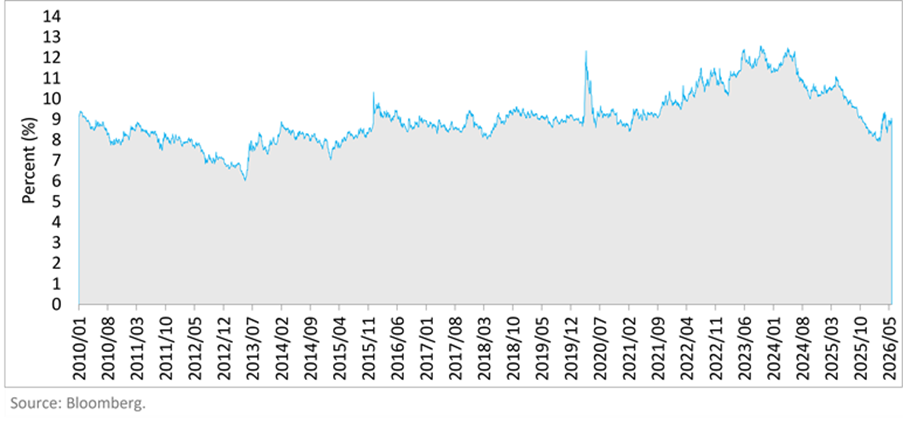

Nonetheless, recent experience once again highlights that bonds are not risk-free. It also reminds investors that risk management remains essential in fixed income portfolios, particularly in a dynamic environment.
What are fixed-income investors to do against a changing global backdrop?
Inflation, the primary threat to real returns, can be especially challenging for investors with lower risk tolerance. Retirees provide a good example. They may have investment horizons of 30 years or more. However, they are often highly risk-averse and unable to tolerate potential capital losses.
Even so, preserving the purchasing power of their income remains critical. At the same time, adding risk assets that can outperform inflation over the long term introduces greater short-term volatility into portfolios.
As responsible stewards of our clients’ capital, we believe our most important role is to provide a safe pair of hands for fixed-income investors. We do not take undue risk with their capital. Instead, we seek to provide as much yield as possible in a responsible and risk-conscious manner that aligns with the fund’s objectives. This disciplined approach becomes even more important in a dynamic environment.
In conclusion
Successfully navigating a changing fixed income environment requires more than identifying opportunities to enhance yield responsibly. Equally important, investors must avoid permanent capital loss.
We believe that long-term success requires a fixed income process that considers both price and risk. Investors must carefully assess the price they pay for an investment while also evaluating the associated risks.