


Paul Stevens | CEO | Just Property | mail me |
South Africa’s electricity framework has been rocked by an error that could cost households dearly.
In August 2025, the National Energy Regulator of South Africa (NERSA) confirmed the R54 billion miscalculation in its revenue decision for Eskom under the Sixth Multi-Year Price Determination (MYPD6). This was not a minor accounting slip. It has real consequences for property owners and tenants, in fact, for anyone who pays an electricity bill.
What happened – the facts
- NERSA admitted that its original MYPD6 revenue decision underestimated certain costs for Eskom. These costs are related particularly to how generation assets were treated.
- Eskom initially applied for R62.676 billion in additional revenue to make up its shortfall. NERSA rejected this full amount and settled on R54 billion after reviewing the application.
- The errors were not minor. NERSA Chairperson Thembani Bukula identified three main mistakes:
- A clerical “version control” error led to the R54 billion miscalculation. It caused a R14.5 billion miscalculation in Eskom’s depreciation allowance for generation.
- An additional R20 billion arose from the incorrect application of the rules for transferring “work under construction” assets into commercial operation.
- A failure occurred in applying the Depreciated Replacement Cost rule. NERSA used zero balances instead of rolling forward prior-year values.
- Crucially, reports suggest NERSA knew of the error before finalising its decision in January 2025. Yet it did not correct it before publishing its official “Reasons for Decision” in June.
Parliament’s Portfolio Committee on Mineral Resources and Energy put affordability in the spotlight. It demanded answers from NERSA on how such a large error could happen and what safeguards would prevent a repeat.
The Democratic Alliance (DA) referred the matter to the Public Protector. The party cited governance failures and technical weaknesses at NERSA. Its complaint highlights the lack of transparency and calls for “consequence management” against those responsible.
NERSA has now commissioned an independent audit to establish how the error occurred and to recommend remedial action. It also suspended a senior staff member who had oversight of the data-entry error. But for ordinary South Africans, already burdened with financial pressure, the result is the same. Higher electricity bills are coming in the years ahead.
What this means for tariffs and your electricity bill
Because of the settlement, Eskom will recover the R54 billion miscalculation over time. This translates into higher electricity tariff increases than originally communicated:
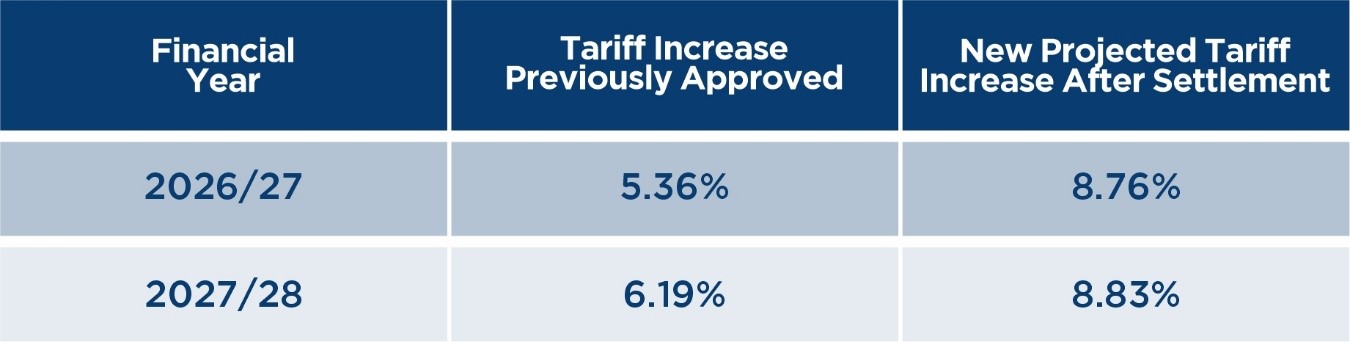

Source: Polity
*These increases are averages; your actual increase will depend on your usage, tariff category (Eskom direct or municipal) and when you consume electricity.
For example, a property owner who currently pays R2,000 per month for electricity under a typical Eskom or municipal tariff could be paying R160–R180 more per month once the new rates are applied, assuming usage remains the same.
Other consequences beyond the monthly bill
Tenants will also feel it. Landlords may pass through higher electricity costs via utilities or service charges.
In rented houses or flats, if electricity is included in rent or partially recovered, expect adjustments:
-
Budgeting pressure
Households will need to plan for bigger monthly bills. This affects how much they can allocate to insurance, rates, or maintenance.
-
Municipal pass-throughs/reselling
Municipalities typically add their own markups. Increases could therefore be even steeper at the local level.
-
Low-income households
Indigent customers may be pushed further into energy poverty. They may cut back on heating, cooling, or lighting.
-
Incentives for efficiency and renewables
Rising tariffs strengthen the case for rooftop solar, batteries, solar water heating, geyser timers, LED lighting and insulation.
Practical steps for homeowners and tenants
While much is beyond individual control, there are constructive actions you can take:
-
Understand your tariff structure
Find out if you buy electricity directly from Eskom or via your municipality. Check whether you are on prepaid, block tariffs, or time-of-use. Review your last year’s usage.
-
Forecast your future costs
Work on an increase of around 8.8 percent for 2026/27 and 2027/28. Plan ahead.
-
Reduce electricity usage
Target high-consumption devices such as geysers, heaters, pools, and large appliances.
Use timers, insulation, LED lighting and energy-efficient appliances. If you are on time-of-use tariffs, schedule heavy usage for cheaper times.
-
Explore renewable and off-grid options
Rooftop solar with a hybrid inverter or battery backup is increasingly cost-effective.
Solar water heating and solar lamps are also practical alternatives.
-
Check for relief programmes
Register for indigent tariffs or free basic electricity if eligible. Make sure you are on the most cost-effective tariff for your household.
-
Advocate for transparency and accountability
Participate in municipal budget consultations. Support calls for greater oversight of NERSA and Eskom’s pricing decisions.
The bigger picture
I believe this error by NERSA, while technical in nature, has serious consequences for everyday South Africans. All of us – homeowners, tenants, and property investors – must brace for higher electricity bills over the next few years.
At the same time, this crisis presents an opportunity. We can accelerate energy efficiency, invest in solar and smarter appliances, and push for more openness and fairness in electricity regulation. If we act now, we can reduce the pain.
Electricity is not just a utility. It is a basic necessity. The burden of mistakes like the R54 billion miscalculation should not fall unfairly on ordinary people.