


Graham Wainer | CEO | Stonehage Fleming | mail me|
If globalisation was powerful for disinflation, de-globalisation is the reverse. We have reached peak globalisation.
The world has reached the limits of economic and political integration. The result is the partial reversal of one of the most important deflationary forces at play in global economies.
Treaties such as Maastricht, the North America Free Trade Agreement, or the World Trade Organisation Agreements were all put in place to drive globalisation, boosting trade and removing barriers between nations.
The reversal
We take trade as a percentage of global GDP from about 5% after WW2 to around 20% in 2022 (see chart 1). All that has now paused and is partly in reverse.
Chart 1
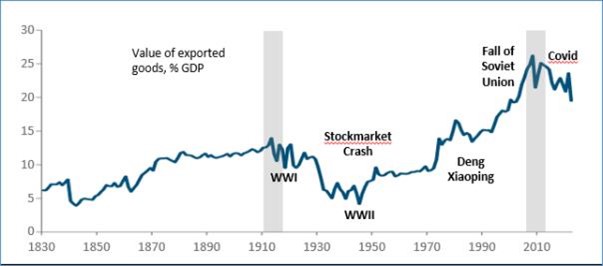

Source: Goldman Sachs, Fouquin and Hugot (CEPII 2016), April 2022
This reversal is due to a combination of powerful geopolitical, economic and social factors. Tensions with US trading partners, for instance, prompted former US President, Donald Trump, to impose tariffs on China, Mexico, Canada and the EU, among others, while in the UK, there has been Brexit.
Furthermore, the global pandemic and outbreak of war in Ukraine have massively impaired supply chains and further shaken investors’, voters’ and governments’ belief in the globalised economic machine.
Lack of resilience in all economies around the world
The COVID-19 crisis laid bare a lack of resilience in all economies around the world. Now, the war in Ukraine has exposed our reliance on energy from bad actors. All this has driven a reversal in globalisation.
Put simply, if you thought that globalisation was a powerful factor for disinflationary trends, de-globalisation has to be working in the reverse. While the transitory effects of inflation will go away in time, economies will continue be subject to the undertow of de-globalisation.
Some structural factors will persist: increasing public debt, unprecedented growth in money supply, underinvestment in global oil resources. And, without globalisation to temper price rises, inflation is going to continue to be a problem for some time to come. It matters to everyone – investment professionals and investors alike.
In conclusion
There is a big difference between inflation of 1, 2 or 4%. It will make a huge difference to investors and to real returns.
“In considering the practical implications of structurally higher inflation, investors and asset allocators may need to revisit their investment strategies. Achieving returns above inflation is central to protecting and growing wealth in real terms. Higher inflation means that investors may need to consider higher allocations to growth assets in their portfolios. This is not always comfortable, given that it comes with added volatility, but may be necessary to improve the likelihood of achieving inflation-beating returns over the long-term.”
– Reyneke van Wyk, Head of Investment Management at Stonehage Fleming (South Africa)