


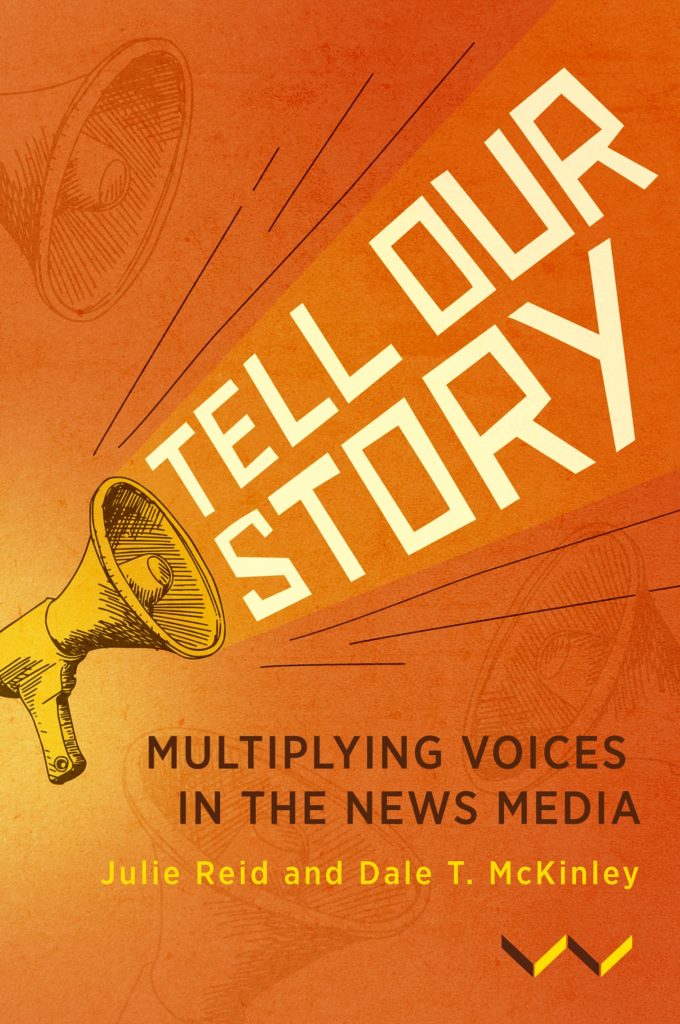
Multiplying voices in the news media
By Julie Reid and Dale T. McKinley
The dominant news media is often accused of reflecting an ‘elite bias’, privileging and foregrounding the interests of a small segment of society, while ignoring the narratives of the majority.
Tell Our Story investigates the problem of disproportionate media representation and offers a hands-on demonstration of listening journalism and research in practice to promote a more active engagement between journalists and local communities.
In the process the authors dismiss the idea that some groups are voiceless, arguing that what is often described is a matter of those groups being deliberately ignored.
The life and struggle community narratives
The authors focus on three communities in South Africa, each presenting with differing but crucial historical, geographical and socio-political ‘characteristics’ of the post-1994 period.
Adopting an audience-centred approach, the authors delve into the life and struggle narratives of each community. They expose the divides between the stories as told by the people in the community who have lived experience of these events, and the way in which these stories are understood and shaped by the media.
The implications of the media’s routine misrepresentation of the voices of the marginalised and poor for media diversity, media credibility and ethics, media education and training, as well as media research are unpacked and the authors offer a useful set of practical guidelines for journalists on the practice of listening journalism.
“Tell Our Story is a valuable addition to the South African discourse on media freedom: the authors examine the issue through the lens of grassroots communities in struggle, within a theoretical framework of listening. Media freedom is most often seen from the point of view of journalists. Here, the emphasis is on the right to be heard, represented, understood, and to be included.“
– Professor Glenda Daniels, Journalism and Media Studies, University of the Witwatersrand
“What sets the book apart from other similar studies in this area is firstly its painstaking empirical work in South African communities (which says a great deal about the authors’ ability to gain the trust of these communities and their own ability to listen to the voices of the people); and secondly its attempt to derive from this interaction practical and concrete suggestions for improvement of journalism that moves beyond a mere critique.“
– Professor Herman Wasserman, Centre for Film and Media Studies, University of Cape Town
“This book offers a fresh and useful approach that will add significantly to the growing body of literature that critiques the mainstream media.“
– Professor Franz Kruger, Journalism and Media Studies, University of the Witwatersrand
About the authors
Julie Reid is Associate Professor in the Department of Communication Science at the
University of South Africa.
Dale T McKinley is Research and Education Officer for the International Labour, Research and Information Group, and Senior Research Associate in the Department of Anthropology and Development Studies at the University of Johannesburg.
- Publisher | Wits University Press |
- ISBN | 978-1-77614-577-5 |
- Recommended Price | R300.00 |
- Subject | Media studies, Cultural Studies |
For more information | Corina van der Spoel | +27 (0)11 717 8705/8700 | mail me |