


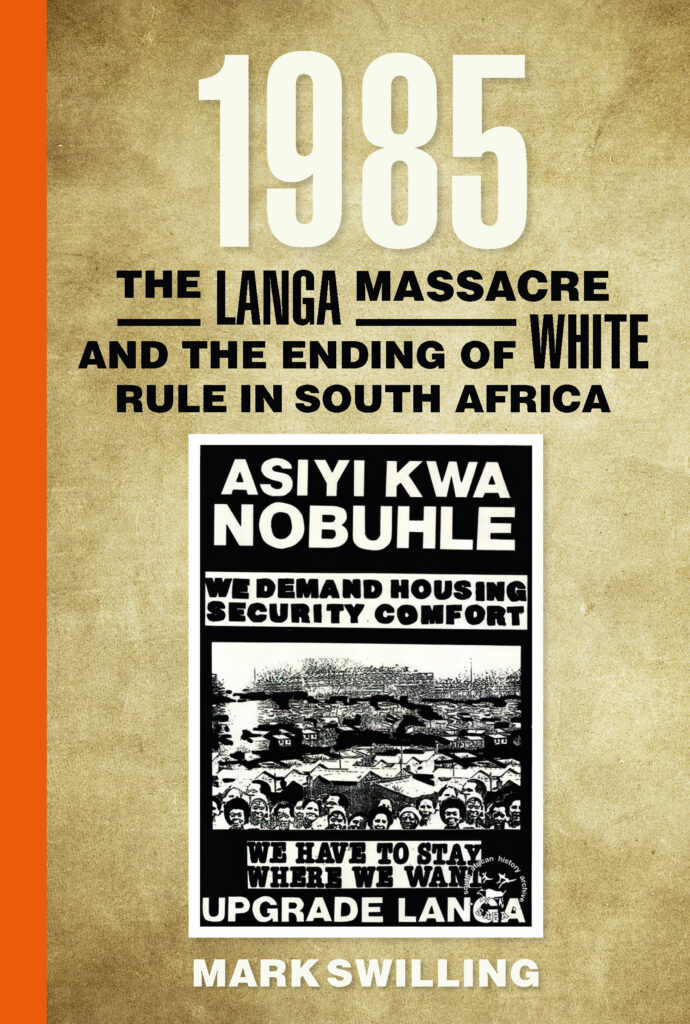
By Mark Swilling
1985: The Langa Massacre and the Ending of White Rule in South Africa revisits a critical moment in the country’s struggle against apartheid. Mark Swilling examines the Langa massacre and the political developments surrounding it. He also considers how events in 1985 helped shift the balance between an authoritarian state and a growing democratic movement.
On 21 March 1985, police opened fire on a funeral procession in Langa township outside Uitenhage. The shootings killed peaceful protesters and sent shockwaves across South Africa and beyond. Forty years later, Swilling returns to this painful history. He reconstructs the events before, during and after the massacre while placing them within the wider political upheavals of the 1980s.
How 1985 changed the political landscape
1985: The Langa Massacre and the Ending of White Rule in South Africa shows why the year became so significant. The apartheid government had become increasingly militarised and authoritarian. At the same time, communities across the country developed stronger forms of resistance. Democratic movements also began building alternatives at local and national levels.
The book places Langa within this changing political environment. Swilling contrasts its consequences with those of the Sharpeville massacre in 1960. After Sharpeville, the apartheid state intensified repression. It banned liberation movements and imprisoned resistance leaders. However, Langa contributed to a different political trajectory.
Swilling connects the massacre to the developments that followed. Four years later, Nelson Mandela left prison. Five years after that, South Africans participated in the country’s first non-racial democratic elections. The book therefore asks how such a transformation became possible.
Importantly, 1985: The Langa Massacre and the Ending of White Rule in South Africa does more than document a historical tragedy. It raises questions that remain relevant today. How can democratic movements challenge authoritarian governments? Can resistance and negotiation happen simultaneously? How can movements build democratic alternatives while an undemocratic system remains in power?
These questions give the book contemporary relevance. As authoritarian and populist politics gain ground globally, South Africa’s 1980s experience offers important lessons. The country’s transition ultimately dismantled apartheid through negotiation and established constitutional democracy.
Overall, 1985: The Langa Massacre and the Ending of White Rule in South Africa provides a thoughtful examination of people, organisations and decisions that changed the country’s history. It encourages readers to understand Langa not simply as a massacre, but as part of a broader political transformation.
About the author
Mark Swilling is a distinguished South African academic, author and public intellectual. His work focuses on governance, political change, sustainability and South Africa’s democratic development.
His expertise provides a valuable perspective on the turbulent politics of the 1980s. Through this lens, Swilling reassesses the Langa massacre and examines the wider forces that contributed to the eventual end of white minority rule.
- PUBLISHER | UJ Press |
- ISBN | 978-1-997468-42-4 |
- Recommended Retail Price | R475.00 |
- Classification | History |